Accelerate Software Development with AI Without Breaking Quality
Accelerate Software Development with AI Without Breaking Quality


The Velocity Trap—and the Moment Everything Changed
It was late. One of those stretches where you’re too tired to second-guess but just awake enough to hit send. “Add custom routes to this WordPress plugin.” That was the whole prompt. In the time it took to refill my coffee, I watched us accelerate software development with AI—276 lines of code landed in the repo. Fully fleshed, not one of those stub-heavy dumps. Real plugin wiring. I spent two minutes waiting and about twenty scanning through a solution that would’ve taken me the better part of an afternoon if I’d written it from scratch.
That wasn’t always the deal. Not long ago, I’d get tripped up chasing a stray semicolon across three files. Syntax errors, mismatched types, weird PHP quirks. That’s how most evenings used to go. You grind through, test each fix, then brace for the next thing to break. The promise of “instant velocity” used to sound like a sales pitch, not a reality.
But everything shifted this past week. Yesterday, with GPT-5 riding shotgun, I pushed thousands of edits—frontend, backend, all the glue—before lunch. It wasn’t a one-trick pony either. It was full-stack, top to bottom, with each change touching multiple layers. This wasn’t a demo project or a quick hack. I’m talking about production-grade, enterprise code. With compliance hoops and systems that actually run real businesses. If you’re thinking this is surface-level, it’s not. Every edit had to survive real-world expectations.
Here’s the catch. The faster you move, the more brittle everything gets. Slow fix/test cycles waste time. When you rip through cross-stack changes without guardrails, you’re stacking up mistakes and tech debt without noticing, and the feeling of progress quickly unravels. If you want velocity that holds up under production fire, you need structure, small, context-rich steps that AI can actually carry forward. You can ship huge, multi-layer changes fast, but only if you bring design, testing, and review closer to the loop. Otherwise, every gain gets eaten by rework. Let’s get into how to build that kind of velocity without blowing up quality.
The Compounding Power of Tight, Context-Rich Steps
The leap isn’t perfect AI code. It’s breaking, fixing, and shipping at a velocity that was impossible before. When AI can carry context from one small change to the next—across backend, frontend, and everything in between—you stop dreading full-stack edits. The real win happens when you cut work into pieces the AI can digest, keep the context focused, and let those pieces build on one another. That’s what stacks up to real speed.
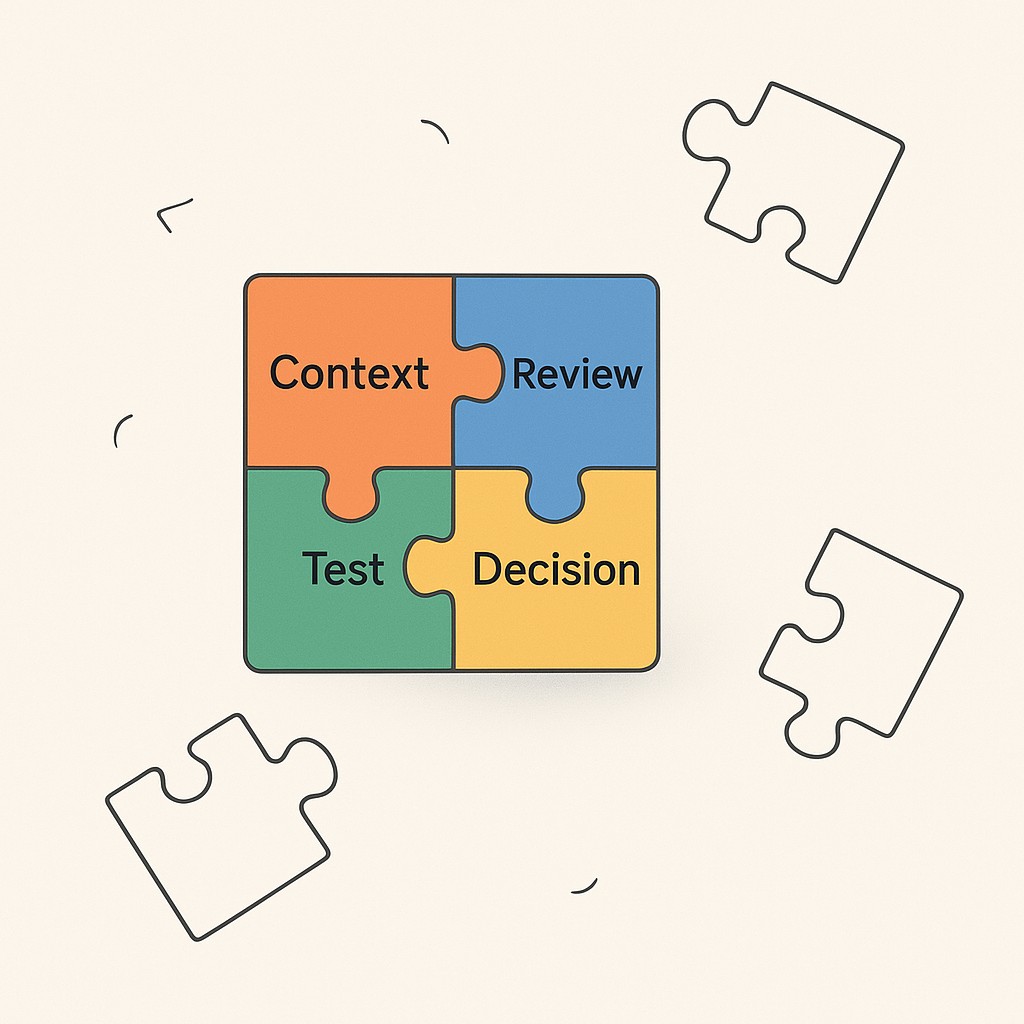
Even after coding with AI for years, I still catch myself getting a little awestruck at how close it gets on the first shot. Not perfect—but it was a moment of awe at how accurate most of it was. Of course, nothing is flawless out of the gate. Things break; the first version never sticks. But the difference is that faster development with AI means you’re fixing and rerunning in minutes instead of hours.
Here’s the flip side. AI doesn’t replace your standards, it amplifies them. If your tests and patterns are lazy, your mistakes multiply just as fast as your features ship. Tighten up your structure, though, and velocity turns into leverage. The quality of what you build is still on you. AI just makes it easier to push both speed and discipline at once.
With great velocity comes great responsibility. The faster and easier it gets to move, the more you have to raise your own bar—especially around architecture, testing, and review.
Think of it like building a jigsaw puzzle, but each piece is handed to you with its neighbors already labeled and double-checked. Instead of dumping 1,000 pieces on the table and hoping they’ll fit, you give the AI a corner piece, it slots it in, and then you give it the next edge. Each prompt drives incremental development with AI—one migration, one route, maybe a well-defined UI tweak.
You prime the AI with exactly what’s on the table, it fits that piece in place, and the context grows more reliable with every step. Framing cuts down back-and-forth, which stabilizes outputs. You’re not trying to get the whole picture in one go. You’re letting quality compound, one precise step at a time. That’s how you get production-grade changes at a pace that just didn’t seem possible before.
A Repeatable Workflow to Accelerate Software Development with AI for Safe, High-Velocity Shipping
Start at the smallest possible unit of change. For me, that means sketching out a concrete user-visible delta—something you could actually click, see, or test end-to-end if it landed tomorrow. Before anything else, I jot down clear acceptance criteria (bullet points, not essays), outline the interfaces or endpoints, and draw hard lines around what’s in and what’s out. These first-draft plans almost never hold up perfectly once I get into the code. That’s fine. You have to spot the gaps before filling them, and you learn by doing the granular work.
Then, give your AI assistant the map. Paste your file structure, spelling out folders, key files, and even where test code lives. Point out the coding conventions you stick to—the good ones and the stubborn legacy patterns. Drop in a sample of a commit you’d call “clean,” or share a diff that nails the right level of detail.
Set expectations for coverage—don’t just say “test it,” specify the cases you want. Here’s what changed for me: When you improve context retrieval, you get a 37.6% boost in accuracy, double the throughput, and memory usage drops 8x—so your AI assistant is more on target and faster in VS Code. It’s wild how leaning in on context turns the AI from a code-dumper into a teammate that persists your design decisions step to step.
Treat every micro-change like it’s headed straight to prod. For each edit—backend route, UI patch, schema tweak—I have the AI auto-generate unit, integration, and route tests as part of the change. I run them locally and in ephemeral previews to shorten feedback loops. Don’t skip this; prod bugs start in staging. The patches almost always need quick fixes—a bad import here, a missing mock there. Make those repairs instantly. Tiny breaks are cheap to fix when you catch them right away. It keeps you in flow and avoids those “where did this even fail?” marathons a week later.
Don’t get sloppy once the code is green. Limit your pull requests—20, 30 lines max if you can help it. Make the AI write a diff summary that directs the reviewer’s attention to what matters. Enforce peer sign-offs. Set automations so merges get blocked if coverage or tests are missing—no exceptions. Velocity flows through guardrails, not around them. Those change impact metrics we lean on? They averaged a 3.2 out of 5 for accuracy, and engineers agreed on them 71% of the time—which makes the review gates worth it.
Honestly, these steps remind me of pit stops in racing. Each micro-change is a fast, choreographed maneuver. You only shave seconds and avoid disaster because the rhythm is disciplined. You could try to cut corners for speed, but the only teams finishing the race are the ones who made the choreography tight.
This workflow takes work, but velocity only compounds when every step is small, checked, and layered with context the AI can leverage next time. That’s the real unlock—not superhuman code, but the confidence and repeatability that comes from structuring each piece so progress and quality move together.
From Mockup to Production: How a Sprint Actually Moves
Let’s start at the front end, since that’s usually where the changes become obvious first. I’ll sketch up a mock—sometimes just a screenshot annotated with highlights and sticky notes. I pass that to my AI assistant and spell out which design system to use, plus which folders and naming patterns to stick to. In a few minutes, it’ll generate new components and tweak the CSS, and if I did a decent job prepping the context, the files will actually land in the right places, following our conventions. You can count on those builds to be more predictable and less prone to silent breakage, because the structure carries forward.
Once the basics look solid, it’s time to dig into the services and wire up the routes. This is usually where the AI shines. I’ll prompt for updated API endpoints and model definitions, and it spits out fresh scaffolds along with matching test shells. By the end of the night, every layer—front end, backend logic, database tweaks—lines up around the same interface names and patterns. It’s wild how fast the architecture converges when context compounds like this.
I keep coming back to that WordPress plugin moment—the anchor for why this approach works. Two minutes later, I got 276 lines of production-grade code, already mapped to our patterns, passing the initial unit tests, and ready to slot straight into our architecture. No stub soup, no hours of patchwork, just usable, reviewable output.
People worry this kind of velocity turns into a mess, but the Git churn tells a different story. In 24 hours, I can add 2012 lines and remove 1341—across frontend, backend, and tests—but every edit goes into reviewed, atomic diffs. That means even though the numbers fly, the changes are controlled. Accelerate software development with AI, but remember that when AI-heavy teams chase speed, instability shoots up—so small, reviewed diffs are how you actually deliver velocity that isn’t reckless. That frame keeps the chaos out of production.
Of course, you can’t just rely on code review alone. The real safety net is in the stack. With continuous delivery with AI, CI pipelines catch test failures before they even sniff production, canary deployments isolate risk, feature flags let you dial up or down, and rollback plans mean you’re never locked into a mistake. The best part is you don’t need a moonshot architecture. Those practices work no matter what tech stack you’re using. Putting those gates in place makes velocity resilient instead of reckless, and you can adopt them before your next sprint lands. That’s how you keep the speed gains real while making sure nothing falls through the cracks.
Building at AI speed? Ship faster with AI: use our app to quickly turn raw notes into clear, context-aware articles, with templates, prompt guidance, and instant drafts ready to review.
Doubts, Discipline, and the Path to Durable Quality
If you’re skeptical about how much time upfront design and prompt priming really save, I get it. I used to think the same way. Laying out clean acceptance criteria and shaping your initial prompts can feel like extra hassle, especially when the urge to just code is strong. But honestly, framing cuts down the back-and-forth, which stabilizes outputs and stops you from redoing work you thought you finished. The more you clarify context at the start, the less mental baggage you carry into the next step. I keep seeing this. The upfront minutes come back as hours saved in rework, and every small gain compounds the next time around.
Speed is only useful if what you ship is safe enough for production. The need for quality checks actually grows, not shrinks, as velocity ramps up. The stack has to hold up under real traffic, real users, and real edge cases, so the basics—architecture, automated tests, peer reviews—aren’t optional. Every edit passes through gates designed for enterprise work, no matter how fast the changes fly.
The fear isn’t just breaking production. It’s making mistakes that hide and snowball, compounding weak judgment. Here’s the difference maker: gates like design reviews, test minimums, and peer approvals don’t slow you down, they amplify good calls and block the bad ones. When you’re moving this fast, weaknesses surface immediately—messy design, shallow coverage, half-baked logic.
They get flagged in hours, not months. That exposure is a gift, not a threat. You learn quickly, iterate faster, and your team’s standards intentionally raise with each cycle. If you trust the process—small diffs, automated checks, required signoffs—you don’t just catch more bugs, you build a habit of improvement baked into the shipping flow. You’re not stacking up debt unseen; you’re building velocity and judgment together, every time AI helps with the next incremental step.
Even now, when I look back on that churn of lines added and removed, it feels like chasing speed might someday clash with durability. I haven’t nailed the perfect balance between shipping fast and keeping every layer maintainable. Sometimes I pick speed and pay for it later, sometimes the other way around.
This is the promise. Compress loops, ship small, let context compound. It’s how you move faster and safer—across frontend, backend, and everything in between—without sacrificing the enterprise-grade quality you need in production.
Pick one change. Ask your assistant to take the next small slice. Do it today. Then keep shipping.
Enjoyed this post? For more insights on engineering leadership, mindful productivity, and navigating the modern workday, follow me on LinkedIn to stay inspired and join the conversation.