Build Evergreen Content Library: Reliable 6-Step System
Build Evergreen Content Library: Reliable 6-Step System


When Every Idea Disappears Overnight
It hit me one morning, scrolling through the same crowded feed, how my best ideas kept getting swallowed by the next wave of posts. I used to scroll, post, repeat—and wonder why my reach didn’t grow. Even the stuff I cared about seemed to vanish the minute I logged off.
What nagged at me wasn’t just the slow trickle of followers. I saw people with huge audiences turning out updates that got a thousand likes and then dropped away, leaving barely a mark. Most of it didn’t stick, honestly. I’d forget their posts almost as quickly as my own. That bothered me more than a thin number under my name. If nobody remembers what you say—even if they see it—build an evergreen content library so your ideas don’t vanish the moment you log off.
Six months ago, I was still chasing the short-term high. At some stage, you have to choose. Do you want flashes of attention or steady visibility? I didn’t want viral—I wanted visible, the kind that doesn’t vanish overnight.
Then I realized the real compounding happens quietly. The next step was obvious. Shift the strategy so that every post works for me over time, not just for one day.
The Mechanics of Compounding Visibility
A feed lures you with instant feedback. You post, you watch reactions roll in, and it feels productive, until the post drifts downstream and all that energy evaporates. But an owned content strategy is different. There, every idea you publish settles into place, building up layer by layer. The real payoff isn’t in the spike you see in hour one. It’s in the steady visibility that keeps working while you’re away. Instead of worrying what’s trending today, you can structure your library so readers (and search engines) keep finding your work long after you log off.
Search engines aren’t fortune tellers or taste marketers. They’re engineered to recognize trust, not vibes. Google doesn’t “like” you—it trusts you. That trust is earned through clarity, usefulness, and consistency. You’re not chasing arbitrary signals. You’re creating material that stands up to scrutiny over time.
So, why does an evergreen content library strategy compound its impact? First, searchable posts get discovered again and again—months or years after you publish. Second, smart interlinking creates network effects: related pieces reinforce each other, making your site a hub rather than loose fragments. Third, authority comes from depth and consistency. Keeping at it signals you’re reliable, not just a one-hit wonder. And finally, liberated from the feed, your evergreen artifacts can be reused across other channels, drawing traffic in while you rest. Compounding plays out in traffic, too—the traffic to one evergreen post nearly doubled in 18 months, driven by these mechanics, according to Moz.
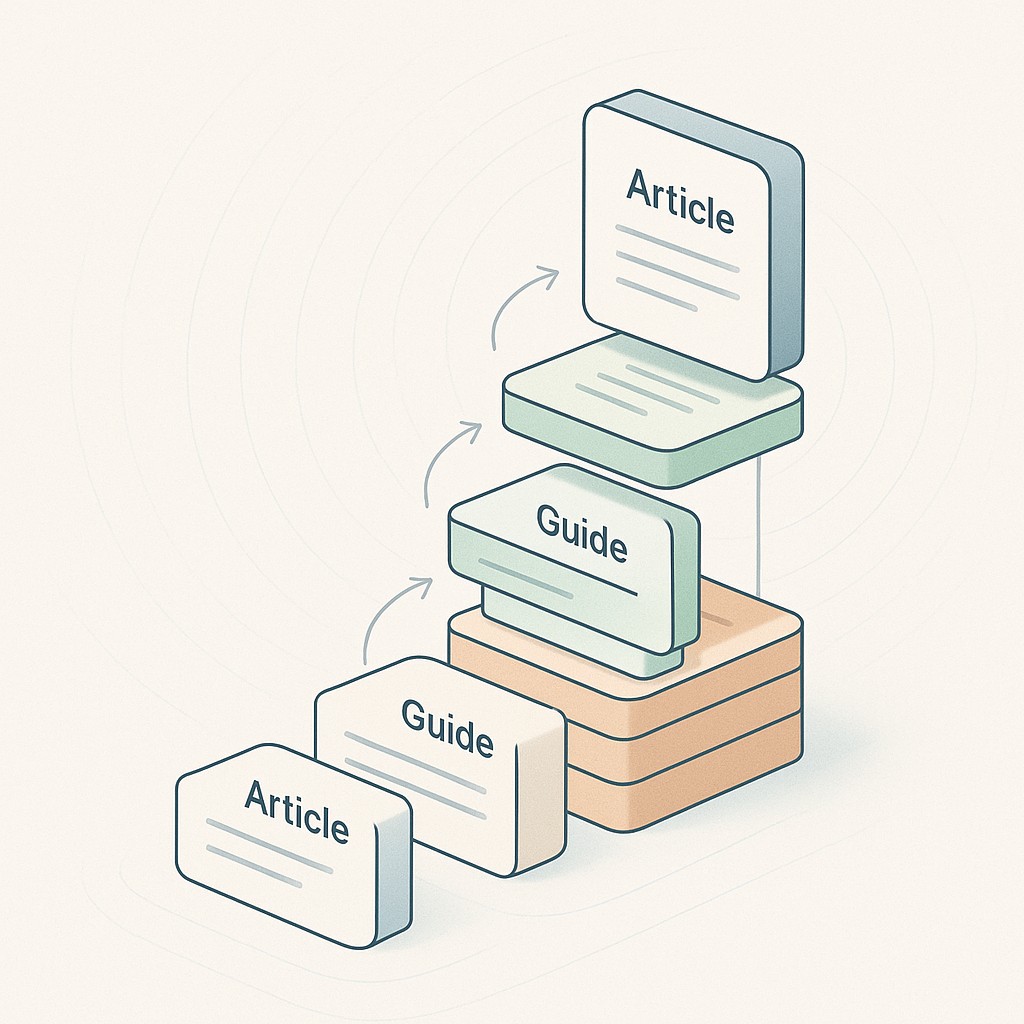
The real trick with interlinking is that it’s double-duty. Internal links help Google find, index, and interpret your pages, making sure your work surfaces in search. At the same time, they guide real readers from one question to the next, turning your site into a navigable web instead of a scattering of disconnected entries. This means not only a longer dwell time but a rising sense of trust, as readers see you’ve mapped the territory, not just dropped content and moved on.
Instead of counting vanished impressions, you start tracking indexed pages, topic coverage, and a rising authority score. Those are the numbers that actually compound. Quietly and reliably. Long after you publish.
Building Durable Artifacts, Not Just Posts
The real shift started when I turned small, fleeting posts into permanent artifacts—lifting them out of the social stream, shaping them on my own domain so they’d stick around and be searchable. This wasn’t about making everything perfect or high-production. It was about taking each idea—no matter how rough—and rebuilding it so it kept its usefulness. The act of publishing suddenly felt substantial, more like setting foundation stones than tossing pebbles into a pond. Each blog entry became a long-lived asset instead of a blink-and-you’ll-miss-it moment.
Here’s the pipeline I landed on: capture a spark (maybe a tweet or a quick note), expand the context so readers know why it matters, add a concrete example, tag it by topic, hit publish, then interlink it with related pieces. It’s simpler than it sounds. If you’re reading this, you’re more than capable of doing each step.
For example, last week, I posted a quick machine learning code snippet in a feed—nothing fancy, just a trick I used to speed up inference. Instead of letting it fade out, I rebuilt the post for my blog. I framed the problem (who actually struggles with slow inference?), walked through the code step-by-step, added simple benchmarks so the tradeoffs were clear, and finished it off with links to related tutorials on optimization and debugging. Now, that one-minute flash lives as a searchable tutorial, cross-linked to a cluster of other ML posts. Instead of being a footnote, it’s a living proof of my approach. It’s still drawing readers days later.
Naming blog slugs feels a lot like naming Git branches. Once, I spent a full minute stuck between final-v2 and speedup-demo and ended up picking neither—just left it as misc3 for a week. When I finally went back, I couldn’t remember what the post was even about until I reread the first paragraph. If you pick something precise—like ml-inference-speedup—future-you will find it instantly. I’ve learned to encode intent in every artifact. “misc-final” belongs nowhere, and a clear slug is an investment you’ll thank yourself for.
With each new artifact, I loop in links to the posts it relates to and reinforce a content hub strategy by pinging back to bigger hub pages. That way, the whole content library gets stronger every time I hit publish. Your domain becomes more search-friendly and human-friendly in one go, reinforcing itself post by post.
Addressing the Doubts: Time, Reach, and Relevance
Let’s talk about the first objection nearly everyone has. The time cost. If you’re like me, you’ve wondered if the push to create a content library is just too big an ask. I won’t sugarcoat it. It takes upfront work. But what you build isn’t just a one-off post. It’s an asset that compounds in value while you sleep. The real magic here is that after investing focused effort early, you dodge the endless context-switching of scrambling for new content every day. You frontload, yes, but that time pays back. The posts keep working and you get breathing room to think strategically instead of playing constant catch-up.
Now, about the fear of losing reach. This one kept me tethered to feeds far longer than it should have. The lesson I finally learned: treat social platforms as distribution channels, not destinations. Post there to announce your work, but always publish first on your own domain so it’s findable tomorrow, next month, or five years from now. If a reader stumbles onto your feed and wants more, make sure that next click leads to a place you control—one built for discovery, not just for the moment’s scroll. Remember earlier when I said Google doesn’t “like” you—it trusts you? That trust starts accruing from the artifacts you own, not from the fleeting posts in someone else’s feed.
The last concern is whether your older work holds up. This is where “evergreen” matters. Evergreen posts aren’t frozen in time—they’re alive. Update a paragraph, tighten a headline, connect it to something new you’ve written, and each piece stays relevant. Small edits and smart interlinks keep your library current in ways the old “set it and forget it” approach never managed. Your work doesn’t just avoid stagnation. It grows roots and new branches.
And if I’m honest, sometimes I still wrestle with whether constantly updating older posts is the best use of time. Some weeks I touch up everything; other weeks, I ignore the whole library and focus on something totally new. I haven’t figured out the right balance yet.
Turn your feed sparks into searchable artifacts on your domain with AI that drafts and expands posts faster, so your library compounds while you code.
If you remember one thing here, make it this: publish first for durability, distribute for reach, and let your library quietly do its work.
Your Blueprint to Build an Evergreen Content Library That Compounds
Pick two or three themes you actually care about and use them to build an evergreen content library—topics where your perspective adds something that a résumé never could. Set a simple weekly cadence. One artifact per week. As you publish, don’t just drop links at the end—connect the dots between posts, making every piece a network, not a silo. The trick isn’t just listing what you did. It’s showing how you think by analyzing context, decisions, and lessons learned. Your library should feel less like a trophy case and more like a map of how you approach problems.
When it comes to sharing, skip the pitch. Publishing a full artifact on your domain becomes your foundation. Then, clip bite-sized insights—quotes, examples, takeaways—for social media, newsletters, or even direct messages to someone who’d genuinely benefit. You’re not pushing. You’re giving evidence that stands on its own.
Measure your compounding content strategy by its steady rhythm, not its traffic spikes. Success is one new artifact a week, making sure each one links to at least one related post. Every quarter, scan your library for simple refreshes; update a sentence, tighten an intro, add a new link, then let the system sit and work independently. The real proof comes months from now, when people discover your work without you lifting a finger.
Here’s the punchline. Durable work is found, not forced. The best kind of trust isn’t pushed on anyone; it’s quietly discovered when you’ve built something worth finding.
Enjoyed this post? For more insights on engineering leadership, mindful productivity, and navigating the modern workday, follow me on LinkedIn to stay inspired and join the conversation.