How to Build Topic Clusters with a Reliable System
How to Build Topic Clusters with a Reliable System


Facing the Mess: Duplication by Accident
A couple months back, I got the gut punch every blogger dreads. Search Console flagged two posts, almost word-for-word on the same topic. I thought I had a system. Turns out, I’d managed to publish the same blog post twice—without even realizing it until the data called me out.
Back then, I really believed good ideas and a working memory would keep me safe from overlap. I didn’t think I’d forget what I’d already said, and I was sure inspiration would keep me moving forward. But, if you’re honest, creative momentum doesn’t build a map. It just leads you blindfolded through your own archive.
Here’s the real cost: instead of learning how to build topic clusters, I was churning out posts just to hit my daily quota, not actually building anything cohesive. Every rush to publish was a distraction from laying out a proper knowledge base.
Some days I’d sit there, brain empty, hoping for an idea that wasn’t just a remix of last week. Other days I’d drown in constraints—search intent, topical authority, SEO best practices—trying to mentally juggle where each new post fit. I always told myself I’d remember everything I published. No surprise: that faith in my own recall ended up stacking problems in my blind spot.
Then came the audit. I dug into Search Console and saw how deep it went. There weren’t just two repeat posts—there were twenty touching on “AI workflows,” each with a slightly different angle or target keyword. It got worse: several posts had promising titles but regurgitated “prompt engineering fundamentals” over and over. Staring at the numbers was humbling. All those efforts had blurred together, competing instead of working as a library. The problem wasn’t that I lacked ideas, just that those ideas lived in chaos—no structure, just scattered bricks where a foundation should have been.
When Repetition Bites Back: How Duplication and Cannibalization Stunt Your Blog
Let’s talk mechanics for a second. When you have multiple pages chasing the same or nearly identical keywords, you trigger keyword cannibalization and split your SEO signals right down the middle Yoast. Instead of one post steadily earning trust for a topic, you end up with two, or five, or twelve posts fighting for attention. Google doesn’t know which to serve up, so you end up diluting your ranking power. It’s like pouring all your creative energy into a leaky bucket and hoping it’ll eventually fill.
Here’s the kicker: repetition works on social, fails for SEO. On Twitter or LinkedIn, you can hammer the same angle from ten directions and actually see better results—people scroll quickly, the feed moves fast, reminders stick. Blogs aren’t like that. The archive builds on itself, and every overlap quietly undermines your authority.
You can’t build authority by winging it. Authority isn’t what you claim—it’s what you systematically cover, what you organize, and what you reinforce with fresh, non-repetitive content.
So the shift is clear: adopt a topic cluster strategy and think like an architect, not a blogger. Mapping your topics, planning clusters, and tracking coverage isn’t overkill. It’s how you craft a library that stacks up, one brick at a time.
I learned this the hard way—staring at my own duplicate posts until the pattern burned in. But when you plan blog topic clusters, untangling that mess isn’t just possible—it’s clarifying. We’re about to move from scattered effort to building something that finally makes sense.
Blueprint for a Cohesive Library: How to Build Topic Clusters, Coverage, and Confidence
It starts with clarity. Strip everything back until you’re looking at just three to five core themes. The backbone of your entire content library. If you’re not sure what your foundational themes are, ask yourself: What topics genuinely matter to my readers, again and again? For me, these turned out to be AI workflows, prompt engineering, creator productivity, audience growth, and sustainable strategy. Your themes will be different, but they’re what hold your efforts together. Write them down. Frame every new idea as a branch of one of these pillars.
Now, build out from those pillars. Design clusters around each theme by learning how to build topic clusters, so individual posts don’t float alone—they connect like spokes to a hub. The real trick isn’t just grouping ideas by gut feel. It’s organizing clusters of 8–10 posts per theme, each designed to support and extend the main idea. Linking your cluster posts back to the main pillar signals to search engines that your hub is the authority on its topic—and keeps its ranking potential high HubSpot. That’s what transforms scattered notes into an actual structure.
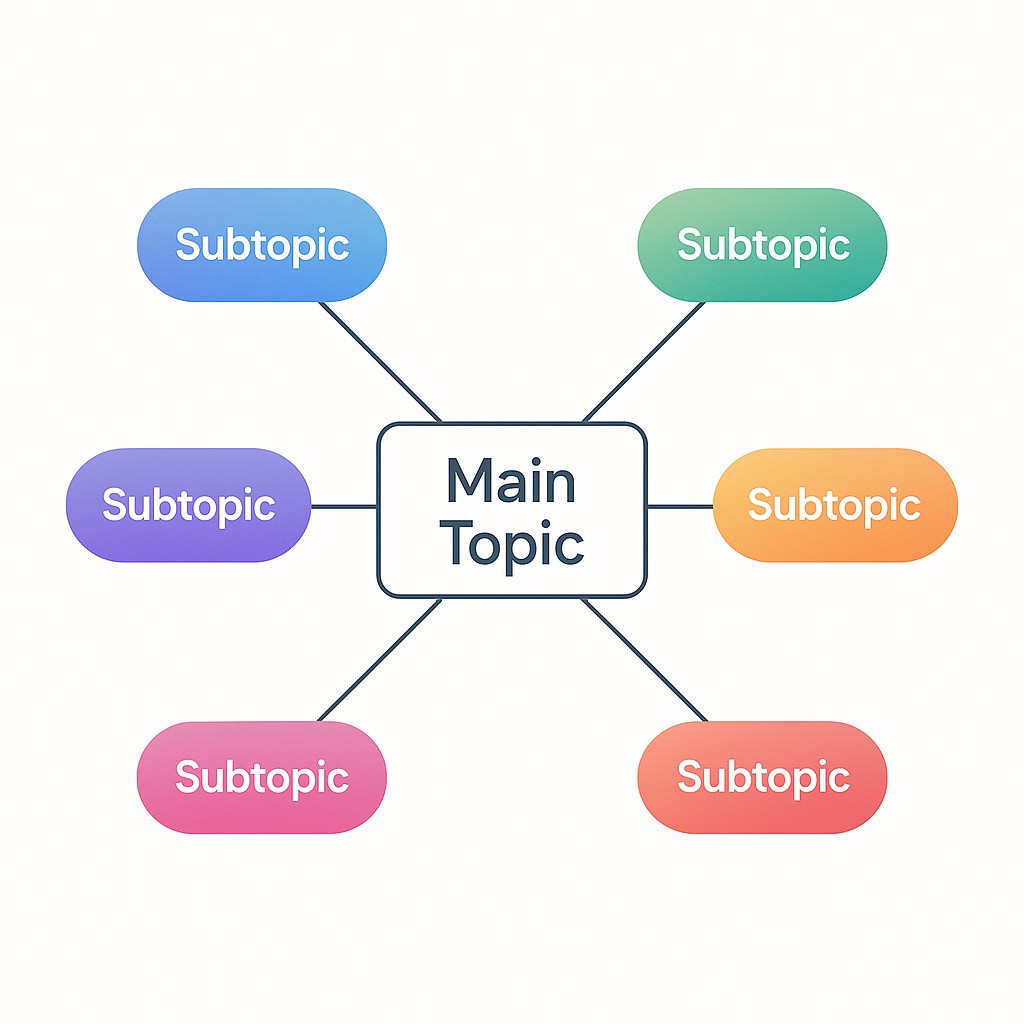
Once you’ve got your clusters laid out, map your keywords with intent to avoid keyword cannibalization. Give each post within a cluster its own distinct set of target keywords—ideally variations and nuances that address different questions or perspectives. This keeps your posts from stepping on each other’s toes in search results, and ensures every new piece adds something new to your topical coverage.
Here’s where things finally clicked for me: set up a coverage tracker—a simple spreadsheet works fine—to log every published post, its cluster, theme, and keywords. I call back to that post audit in Search Console; this tracker is now my early-warning system against repeat topics and accidental cannibalization. It also turns spotting gaps into simple content gap analysis, so I know exactly what needs writing next.
Quick tangent—don’t underestimate labeling. I finally organized my spice jars last winter. Ten years in the same apartment and I had just been guessing whether the cumin was in the second jar from the left or actually paprika in disguise. Once everything was labeled, dinners went smoother. I spent less time hunting and more time actually cooking (and yes, fewer weird flavors in the chili). Labeling content clusters creates the same clarity. You know where everything lives and what’s missing.
Now, set a cadence and pipeline grounded in content cluster planning that fits both your style and the bigger system. If you’re used to firing off LinkedIn posts in the moment, keep that voice. Just plug ideas into your mapped-out cluster before drafting the blog version. I build a monthly publishing calendar around my coverage tracker and adjust weekly as new questions or trends pop up. Some weeks, I focus all-in on one cluster; others, I mix posts from two if connections appear. The system isn’t there to kill spontaneity, but to channel it. You’ll find you’re no longer guessing what to write next—you have a living library guiding every decision, making each post count.
Audit, Clean, Advance: Keeping Your Content Library Cohesive
Start with the audit. Don’t overthink it. I opened Search Console, filtered by my main keywords (“AI workflows,” “prompt engineering fundamentals,” etc.), and compared impressions and click-throughs for posts with suspiciously similar titles. You’ll spot overlaps pretty quick: same headline structure, paragraphs copy-pasted, or different intros leading to the exact advice. Even just sorting by URL can surface the doubles or near-doubles. If you want a shortcut, plug your sitemap into a simple spreadsheet, label posts by theme, and scan for clear repeats. It’s not a glamorous process, but it’s the one that let me finally see how deep the duplicates ran.
Here’s a concrete example: I thought I was “diversifying” by writing separate pieces on “AI workflows” and “prompt engineering fundamentals.” Turns out, half the workflow articles were just prompt basics stretched thin. If you’re facing this, stop and ask—are your AI workflow posts just rehashing prompt fundamentals in fancy packaging? If so, they’re not serving your readers or your SEO.
So, what now? When duplication appears, you’ve got a choice: merge, redirect, or rewrite. Look at intent first—are these posts truly different, or just variations? Performance matters too; if one post has solid backlinks and rankings, keep it as the main pillar.
Sometimes merging the best of two into a single, deeper resource is the move. In other cases, use redirects to funnel traffic and signals to one authoritative page. Don’t leave scattered posts splitting the topic. When backlinks scatter across pages aiming for the same keyword, you’ll never build real authority—cleaning up that dilution is non-negotiable Oncrawl. If neither post stands out, a rewrite lets you start fresh, finally covering the topic from a unique angle. Be ruthless. Every post not serving the library’s clarity is just background noise.
Once you fix duplication, update your coverage tracker—mark merged posts, note redirects, and record what’s still needed. Every new post should advance your overall library, not just add volume. If you’re not seeing this in black-and-white, you’re trusting memory when you should be trusting your system. Look back at that Search Console moment—the day you realize you’d wasted a publishing day because you forgot you’d already said it all—and let that be the line you don’t cross again.
Use Captain AI to generate a free, on-theme draft for your next cluster post, so you can skip the blank page, edit for intent and links, and publish without risking duplication.
Addressing Hesitation: Time, Spontaneity, and Cleanup
The time you put into building your content library isn’t just another admin chore. It’s how you compound clarity and authority, post after post. Forget scrambling for daily ideas. Each decision now builds on the last.
If you’re worried about losing creative freedom, don’t—what works as repetition on social media sparks engagement, but in blogging, overlap fails SEO and muddies your expertise. Save the quick-hit hot takes for your social channels, where you can loop a message ten different ways. Your content library is where you dig deep and fill gaps with substance, confident you’re not echoing yourself.
This is your marker to shift focus. Stop thinking in quotas; start thinking like an architect. The foundation you lay now is what will hold up everything you build next.
And honestly, sometimes I still catch myself circling an old theme, halfway into a draft before I think—wait, didn’t I cover this back in January? I’m not sure I’ll ever catch every single overlap in advance. But as long as the structure is in place, I can live with the occasional near-miss.
Enjoyed this post? For more insights on engineering leadership, mindful productivity, and navigating the modern workday, follow me on LinkedIn to stay inspired and join the conversation.