AI-proof real-world moats: Build where atoms win
AI-proof real-world moats: Build where atoms win


The Moment the Ground Shifted
A few nights ago, I found myself watching a post-labor economics video. One of those late scrolls where, halfway through, you realize you’re not just learning—you’re recalibrating. The kind of thing that makes you stare at the ceiling for a while.
The truth is, I don’t keep building just for the next payout. I do this work because making things—shipping, wrestling with the unknown, getting it right, then getting it wrong and trying again—is wired into how I think of myself. It’s not about the paycheck. It’s identity.
But then the uncomfortable follow-up: what’s worth building when AGI can out-build me?
I caught myself looking at manufacturing roles that build AI-proof real-world moats the other day. That should tell you something. If you’d asked me a few years ago, I’d have bet on digital leverage forever. But here’s what’s changed: digital isn’t the moat I thought it was. Now, what’s grabbing my attention isn’t the next SaaS tool—it’s places where atoms, not bits, set the tempo. Where friction is back in the equation.
Digital won by removing friction. But that frictionlessness might be its fatal flaw. Every founder and operator I know is feeling it—content and services we thought of as differentiated have gotten cheaper, easier, and, like it or not, more replaceable. In the last year alone, graphic design jobs dropped 13%, writing gigs fell 30%, and coding work slipped 20%—the ground’s already shifting beneath digital services. All the optimizations that gave us digital scale now make it trivial for AI to copy or outright erase us from the value chain. The identity we built as creators or operators—pricing power and pride included—can vanish overnight. No moat, just a high score on replaceability.
That’s the pain. And it’s why I’m now searching for work that physics, not just software, makes defensible.
Atoms Slow You Down (That’s Good)
Here’s the blunt version. Physics-constrained businesses, with logistics and boots-on-the-ground execution, do something digital never could. They slow down replication and automation. That friction buys you time and gives real moats. Digital, for all its speed and scale, doesn’t put up any resistance. If you can clone it overnight, so can everyone else. You probably already feel the difference.
Let’s make it concrete. Working with atoms—physical stuff—means you’re constantly wrestling with material limits. Things have to move, get stored, inspected, approved, shipped. Even if you automate half the process with robots and software, you’re up against bottlenecks that simply won’t budge. You see it when flooding hits seven of Thailand’s largest industrial estates, and suddenly global auto and electronics supply chains take a hit—reminding us how physical bottlenecks ripple out. When factories go offline, there’s no patch to push, no instant revert. The world has to wait.
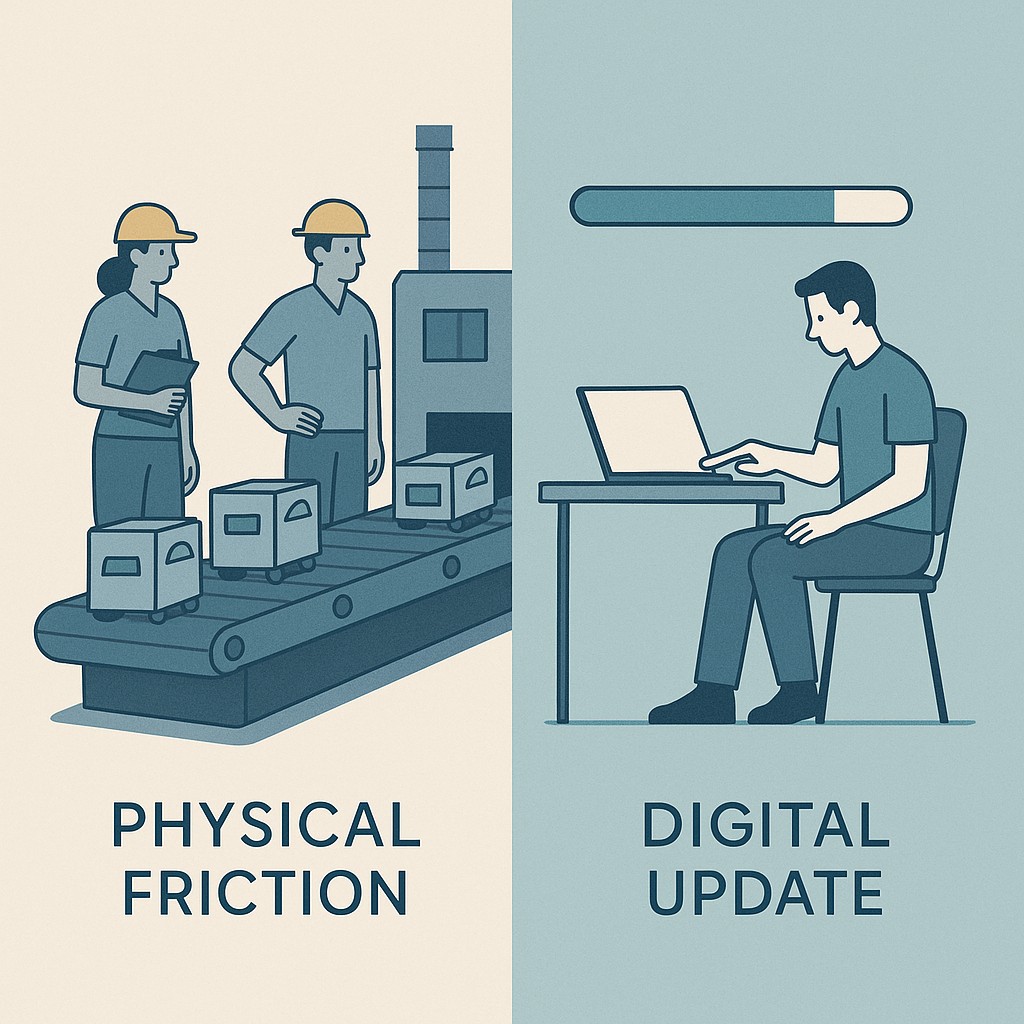
Now compare that to digital. Bits move at zero marginal cost. Updates go everywhere at once, whether it’s code, content, or a new product. Iteration cycles collapse from months to minutes—sometimes less. Zero marginal cost, infinite scale, instant iteration. That’s the beauty and the trap.
But here’s the irony: that same frictionlessness is exactly why AI will eat it first. The regions where generative AI lands hardest are knowledge work and decision-heavy roles—the very areas that once felt safest from automation.
The lesson’s sharp. If you want work that lasts, look to where atoms, distance, and time still matter. That’s where the moats are—and where builders get to stay irreplaceable a little longer.
The Replication Risk Audit: Where Do AI-Proof Real-World Moats Live?
If you want to know whether you have real-world defensibility or are just convenient, start here. Where do physics, logistics, or on-the-ground execution slow things down—and where do they not? I know it’s tempting to assume “being really good at X” is enough. I’ve made that mistake. This is different.
First, rate your offering by atom-bound friction. Does delivering what you sell require time, moving materials, physical installation, or handling in the real world? For instance: shipping hardware, site visits, dropping off equipment—or even just making sure a thing actually fits through the door. Friction is your friend here. Put yourself on a simple scale. Zero means pure digital (anyone, anywhere, instant). Ten is a service so tangled in physics a drone drop couldn’t replace it.
Next up: local execution. Does your roadmap touch work that depends on permits, local vendors, site access quirks, or region-specific regulations? If you’re deep in the weeds organizing a cross-town installation or dealing with three layers of compliance just to plug something in, you’re in “local execution” territory. Most digital-first operators underestimate how messy (and defensible) this is. If you’re not contending with these headaches, ask yourself who is—and whether that’s where the moat actually lives.
Third: digital leverage married to physical bottlenecks. This is worth gold if you get it right. Can your code, data, or automations make physical work faster—by improving planning, scheduling, or real-world QA—while still relying on the fact that someone, somewhere, has to show up or move atoms? Here’s where you get the best of both worlds. Update once, deploy everywhere, but only as fast as atoms allow. Digital scale meets physical constraints.
Let me walk this down to ground level. Picture an analytics-focused agency that’s being commoditized—their dashboards, their reports, even their bespoke data models now churned out by AI in seconds. If you’re that agency, you pivot. Instead of just advice, you add on-site implementation audits. You send someone to the warehouse to see why the data’s dirty, or to the retail floor to trace the missing scanner. You coordinate directly with vendors to fix upstream issues—no more assuming the client will “just do it.”
You bake in logistics scheduling, so the “last mile” isn’t a blind spot but a deliverable. Suddenly, much of your value isn’t copy-pastable. It’s coordinated, physical, often sweaty. Your dashboards still matter, but their impact comes from hands-on change you can actually verify. That’s defending your work where replication is genuinely hard.
Take a hard look at your offerings through these three lenses to identify AI-proof real-world moats. Once you spot where physics slows things down, that’s where the new roadmap lives. It’s less about what digital can do—and a lot more about how digital makes the tough, physical parts less painful and more valuable. There’s your moat, and your role, surviving AI saturation.
Roadmapping Toward Durable Value—The Hard Path
Here’s the clear directive. Move 30–50% of your roadmap into work that’s anchored in physics and local execution, then layer digital capabilities on top for leverage. If half your future output could be cloned overnight, what’s the point? Let friction earn its keep.
Start by taking inventory of your real assets. That means listing out unique relationships, regional know-how, hard-to-access equipment, and any process IP you’ve built up. Don’t gloss over the little stuff. Map each to where friction still exists—where getting it done takes more than pulling up a repo or flipping a toggle. Be honest. Six months ago, I glossed over the actual maintenance contracts we’d built with regional vendors, figuring our software lead would always be our edge. That was a mistake. I’ve skipped this step before, convinced my digital toolkit was “good enough,” only to find out I was easy to outpace.
Now, design hybrid physical-digital models on top of those assets. The goal isn’t to go all-in on atoms, but to bundle your software (SaaS, custom data, analytics) with managed services, on-site ops, or even hardware kits. Anchor some chunk of the product in real-world bottlenecks—installation, delivery, training, local audit—so the value gets locked in where instant replication breaks down. If your best software feature can be used anywhere, but the “magic” happens during on-site deployment, that’s where you put your pricing power. It’s the hybrid bundle that slows copycats down.
Quick tangent: last weekend I spent an hour fixing a stubborn bike chain. The mess, the oil under my nails, swearing quietly in the late afternoon. In that moment, satisfaction came entirely from friction I could feel—metal resisting, tension finally giving, the gears snapping back into place. Nothing digital hits quite like that. I think about that tactile payoff every time I debate whether one more dashboard feature could matter as much as something you have to physically wrangle with.
After you’ve sketched your hybrid roadmap, build up logistics-based moats through supplier partnerships around the new constraints. Secure calendar slots with local providers, negotiate minimum order quantities, and get your hands into crew training. Use AI or robotics where they amplify what’s hard—not where they erase the human element entirely. It’s one thing to automate the paperwork or route optimization; it’s another to expect software to fix everything hands-off. What you want is digital scale supporting physical execution, and the slow parts keeping you defensible.
What this looks like is different depending on your role. Picture the solopreneur. Instead of templated dashboards, they offer a quarterly on-site data-to-decision workshop, walking local teams through the messy realities. The agency stuck in pricing battles? They start bundling their analytics subscription with in-person installation QA, not just remote support.
For the SaaS founder, it could mean shipping out hardware-enabled monitoring kits, bundled with local service coverage—so setup isn’t just plug-and-play, but actually requires boots in the region. If you’re hearing a callback to earlier, you should be—each example turns commodity bits into friction-bound value. You, the reader, know your capabilities best, but the shift is about seeing where work can’t be instantly cloned and making that part a non-negotiable slice of what you build.
If you walk this path, you restore something we’ve all felt slipping: durability, pricing power, and a builder’s identity that survives more than one technology cycle. The friction’s real. Lean into it.
Doubts, Doubts, Doubts—Why Changing Your Roadmap Feels Risky
Let’s be honest. There’s a lot to worry about when you actually try to move toward hybrid or atom-bound work. You have to invest more time, you’re afraid you’ll give up the scale that made your digital playbook work, you’re not sure this even fits your brand, and half of you thinks “physical constraints” just means smaller margins and more headaches. I’ve sat with all four of those doubts—still do, honestly. Even after seeing the warning signs, I catch myself slipping back into looking for those clean, always-on digital wins.
But here’s the reframing I wish I’d had earlier. Friction isn’t overhead—it’s what creates durability and pricing power. When you bundle digital speed with physical anchors, you actually keep your ability to scale (and sometimes make it stickier). Brand? It gets stronger, not weaker, when it’s tied to outcomes that exist, not just ones you claim in pixels. As for physical constraints, you don’t have to go it alone. Networks, partners, and clear playbooks let you replicate what works without falling into the “just another commodity” trap. It’s a shift, but it beats fighting an AI arms race on the open web.
If content has been a headache, use Captain AI to generate a clear, on-brand article in minutes, then edit and ship with confidence—free to create.
At the core, deciding to do more atom-bound or hybrid work is an AI-proof career strategy grounded in identity. You’re choosing to operate where your work persists, shows up in the real world, and can’t be cloned away in a click—even as the rest gets faster and cheaper around you.
So here’s what you do next. Pick one current offering and add a physical or local execution layer. Commit 90 days and shift 30–50% of the roadmap to work where friction is doing the defending. That’s how you build a moat nobody can copy overnight.
Enjoyed this post? For more insights on engineering leadership, mindful productivity, and navigating the modern workday, follow me on LinkedIn to stay inspired and join the conversation.