The One-Sentence Way to Clarify Product Messaging
The One-Sentence Way to Clarify Product Messaging


The One-Sentence Wake-Up Call
A few months ago, embarrassingly far into building Captain AI, I realized I couldn’t sum up the product in one sentence. Not even close. That blank stare moment hit harder than I expected—it wasn’t just a pitch problem, it was a sign something bigger was off.
Here’s the trap: founder-operators like us get pulled into building every cool feature customers mention until the lines blur. Most founders stay stuck in the middle, building everything, owning nothing.
When you clarify product messaging, it isn’t just a tagline—it’s your first conversion moment. Most people land on a new page and just scan it—79% scan, only 16% actually read every word, which means instant clarity wins. If your relevance isn’t obvious, the rest doesn’t matter. They won’t stick around to uncover the brilliance hiding under a muddled headline.
You get three seconds, tops, before they’ve decided if you’re worth more of their attention. That’s the whole game.
Choose What You Own—Clarity Follows
If you choose what you own, your value becomes explainable. Every decision downstream gets easier. That’s it. Defining strict boundaries is the not-so-secret move that clears the fog.
Constraints aren’t a cage; they’re your shovel and flashlight. Instead of wading through every feature suggestion, boundaries anchor your attention where it counts. They cut the noise, let you see what matters for your audience, and make it clear what’s out of scope. Too narrow and you’re a commodity. Too broad and you’re delusional. It’s finding the center line that keeps you sharp.
Six months ago, I wasn’t thinking about how to stop feature creep at all. I thought expanding the feature set would make us unstoppable. But the more we added, the less sense the product made—both to me and definitely to anyone landing on our site.
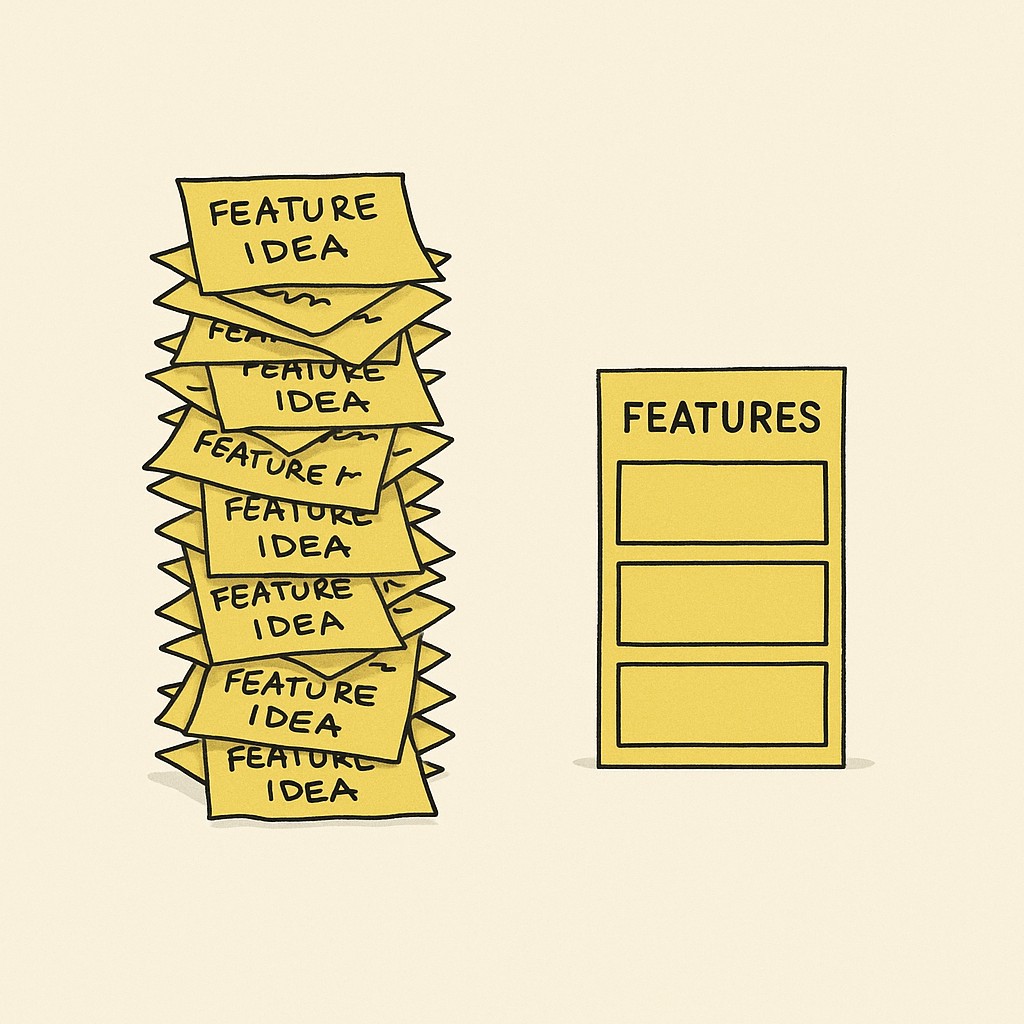
Now, I hear the doubts every time: How much time will it steal to pare things back? What if I cut features and shrink our opportunity? Isn’t a one-sentence statement going to flatten everything I’ve built into a soundbite? These aren’t fake worries—they’re the real friction points for every founder-operator I know, including me.
But here’s a simple test you need to run—can you state a one-sentence value proposition? If you can’t literally explain your product in one sentence—for a specific problem, for a specific audience—your product doesn’t have boundaries; it has wishlist items. Use that discomfort. It’s telling you where you’re fuzzy.
We’ll get practical, fast. You’ll have clarity before the end of today—not someday after another quarter of iteration. Let’s do this now.
Draw the Line—How Boundaries Turned Captain AI from “Everything” to “Anything But”
Step one to clarify value proposition was staring the problem in the face. Could I tell another founder, in one sentence, who Captain AI was built for and what outcome we deliver? I forced myself to keep it plain. “Captain AI helps founders publish content at scale.” That’s it—audience, promise, no hedging.
I ran this through the Value Proposition Canvas to be sure: running your value statement through something like the Value Proposition Canvas helps make sure you’re locking in what real customers care about source. It kept the focus on founders overwhelmed by content overhead, not just “anyone making stuff online.” It felt restrictive at first. But every time I went broader, the sentence got longer and the meaning faded. Naming the boundary actually simplified things. One target user, one measurable outcome.
Step two was brutal but obvious once I started—a feature audit to define product scope, matching every bullet on our roadmap against the value statement. SEO research? In. Content generation? In. Paid ad campaign management? Out. We had to decide, out loud, what was officially “our job” and what wasn’t. Cutting edge cases and dangling pipelines hurt at first, but the payoff was instant. Focus, everywhere.
The litmus test came right after. I fired our one-liner into a couple DMs and watched. Did founders know this was for them? Were their problems in our wheelhouse, or did they ask for stuff we’d just said no to? For the first time, I had actual signals. A week earlier, my inbox was full of “does this do X… or Y… or Z?”—all vague. Now people wrote back, “I need that,” or, “Not for me, but I know who it’s for.” That sharpness changed how I thought about every roadmap debate.
With a clean line drawn, product messaging for founders snapped Captain AI into a new shape. An automated inbound marketing system built for founders who want to publish at scale, without the agency sticker shock. Out went the half-built ad tools and custom campaign logic. We stopped being “maybe everything” and became “absolutely this.”
This next bit feels like an odd comparison, but it stuck with me. I spent almost twenty minutes once trying to pick a movie on Netflix with my brother. Neither of us wanted to commit until the other gave a clear yes. We scrolled, read summaries, started trailers, then went back to the top. At some point I realized I’d have watched anything if someone had just picked. That same hum—the relief when things are simply decided—hit when we finally cut our feature list down for Captain AI. It’s not about variety. It’s about making a call so you can move on, even if you aren’t sure it’s perfect.
Zooming back: setting boundaries for Captain AI took me from “should we add this?” to “does it serve founders publishing at scale?” I still wince thinking about the features that didn’t make the cut. But focus is what made progress possible. If you’re sitting with a fuzzy pitch or a roadmap with too many maybes, take the next hour and run this exercise. You’ll surprise yourself—sometimes, drawing the boundary is the most generous thing you can do for your own product.
Landing Pages, Social Posts, and Cold Emails—Clarify Product Messaging Where It Counts
Turning your one-sentence value into action isn’t complicated—clarify product messaging and echo that clarity right into your landing page hero, your LinkedIn hook, and the first lines of your cold emails. This is your first and sharpest conversion gate. If someone lands on your homepage or sees your social post and doesn’t get why you’re relevant, you’re done before you started.
Landing pages need to pass a three-second relevance test. Your headline promises an outcome for a specific audience, not vague superpowers. Drop one line of context right underneath—what, for whom, how. Then, give three bullet points that map your sharpest features to that promise. Make sure every line can be scanned in a half-second. People mostly scan—your headline needs to be concise and scannable if you want that 3-second win source. Don’t bury the lead. Make every word play offense.
For LinkedIn, keep it blunt. Open with your one-sentence value, add a practical insight (“We automated 80% of our posts—no more agency runaround”), then a single call to action. “Building for founders? DM for a teardown.” That’s it. One scroll, instant relevance, clear next step.
Cold email? Start with the exact pain you solve, who you solve it for, one crisp example (“Launched 30 branded posts in a week for LastNameAI—no agency, zero meetings”), and close with a no-pressure ask. “Can I send you the deck?” Quick, personal, no confusion.
Here’s the gut check. Rewrite every headline and CTA you touch. Does it map perfectly to your one-sentence promise? If not, cut it—or tighten until it does. That’s what gets people off the fence and into action.
Put your one-sentence promise to work—use Captain AI to draft a focused article in minutes for free, test your messaging on a real page, and publish without agencies or headaches.
Keep the Line: Why Boundaries Sustain Progress (and Save Your Roadmap)
Boundaries aren’t just a theoretical exercise. They’re the fastest way to keep the whole ship pointed in one direction. Every feature only makes the cut if it’s clearly traceable to your one-sentence promise. That means roadmaps get tighter, fewer distractions, and you stop burning hours debating features that don’t actually move you forward. Audit every “maybe” against the line. Now you’re executing, not just dreaming.
Let’s be real. Saying “no” feels like you’re closing doors. Early on, I worried that if I drew hard boundaries, I’d shrink our potential and short-circuit the chance for a breakout feature. Turns out, the exact opposite happens—you get attention and momentum where it counts. Framing cuts down back-and-forth, which means you spend less time clarifying, more time building. The opportunity isn’t lost. It’s compressed into something others can finally recognize and act on. One clear promise actually opens more real conversations (and honestly, it saves you from exhaustion).
You don’t need a drawn-out process to keep this sharp. Run a boundary checklist once a week. Does every live feature and new idea pass your “one-sentence” filter? Do a quick message tune-up monthly—refresh your homepage, social bios, or cold templates for drift. Every quarter, audit your roadmap and pile old “dream” features into a parking lot. That’s enough. Set a recurring 20-minute window in your calendar and stick to it.
I’ll admit—I still catch myself wanting to sneak in just one more “nice-to-have” every so often. The urge doesn’t go away completely. Maybe it never will and maybe that’s okay. I haven’t totally solved that part. The only thing I know for sure is boundaries are what keep the whole ship moving, even if it means leaving a few ideas behind.
If you’re in, commit. Pick your line. Say it in a sentence, and only ship what stays on the inside. That’s how you keep clarity, conserve energy, and actually get somewhere.
Enjoyed this post? For more insights on engineering leadership, mindful productivity, and navigating the modern workday, follow me on LinkedIn to stay inspired and join the conversation.