Make Content More Linkable: Essential Upgrades for Earning Natural Links
Make Content More Linkable: Essential Upgrades for Earning Natural Links


Why Great Content Isn’t Enough
You put in the work—sweating over what to say, polishing and sourcing, sometimes burning a whole week on a single guide—and almost nothing changes. The traffic numbers don’t move, no one links it, and the shares trickle in, if at all. I’ve been there.
When I first started writing, my playbook was simple. Share what I know, write it clearly, and expect it to count for something. It wasn’t until I began to focus on how to make content more linkable that I realized just writing wasn’t enough.
I thought great content would naturally share itself. It doesn’t. The world isn’t waiting to promote your best advice just because you’ve written it up well.
What I kept seeing—and maybe you’ve felt this too—was that even solid, actionable articles based on what I actually did would slip quietly into the archive. No citations, no organic mentions, rarely a new lead or partnership. Just another page in the pile.
There comes a point where you start questioning the whole process. Is this worth the time? Am I missing something basic? That restless itch eventually led me to look for a better way—a way to make content that doesn’t just inform, but actually gets seen, cited, and talked about.
The Moment I Saw What Actually Works
Looking back, there was a point—after maybe a dozen published posts—where I finally stopped and compared numbers. Some pieces just sat there. Others got picked up, cited, dropped into resource lists I’d never even heard of. It wasn’t random. Patterns started to show.
The breakthrough felt simple, but it was the turning point. The posts that became shortcuts for others, broke big ideas down step by step, or equipped people with fill-in-the-blank tools pulled far more weight. When you break down big ideas or provide ready-to-use tools and fresh updates, you open the door to thousands of backlinks—like HubSpot’s persona guide, which pulled links from industry leaders and stuck around for years (Buffer, Social Media Examiner, Neil Patel). With those, the links came in because others wanted the shortcut, not just the information.
Here’s the difference I keep coming back to. Some content informs. Some makes people want to share what they found. Only a handful end up as the link everyone reaches for when they need proof or a template.
The assets that landed—really landed—were usually guides so comprehensive people cited them instead of explaining themselves, or frictionless resources anyone could swipe and use without edits. Every field has these. The opportunity to turn articles into resources arises with the cheat sheets that show up in ten different presentations, and the templates saving teams hours.
Some campaigns don’t just boost content shares—they explode, racking up nearly 600 press features, celebrity mentions, and hundreds of thousands of shares in weeks BuzzFeed, Huffington Post, celebrities like Sofia Vergara. That’s not luck. It’s the payoff for building what nobody else wants to rewrite from scratch.
So here’s the core thesis that finally stuck for me. Content only earns links when it’s seen as a go-to reference or is frictionless for others to share. That’s the bar. Everything else is just another helpful post—easily lost, rarely mentioned, quickly forgotten.
How to Make Content More Linkable and Turn It Into a Linkable Asset
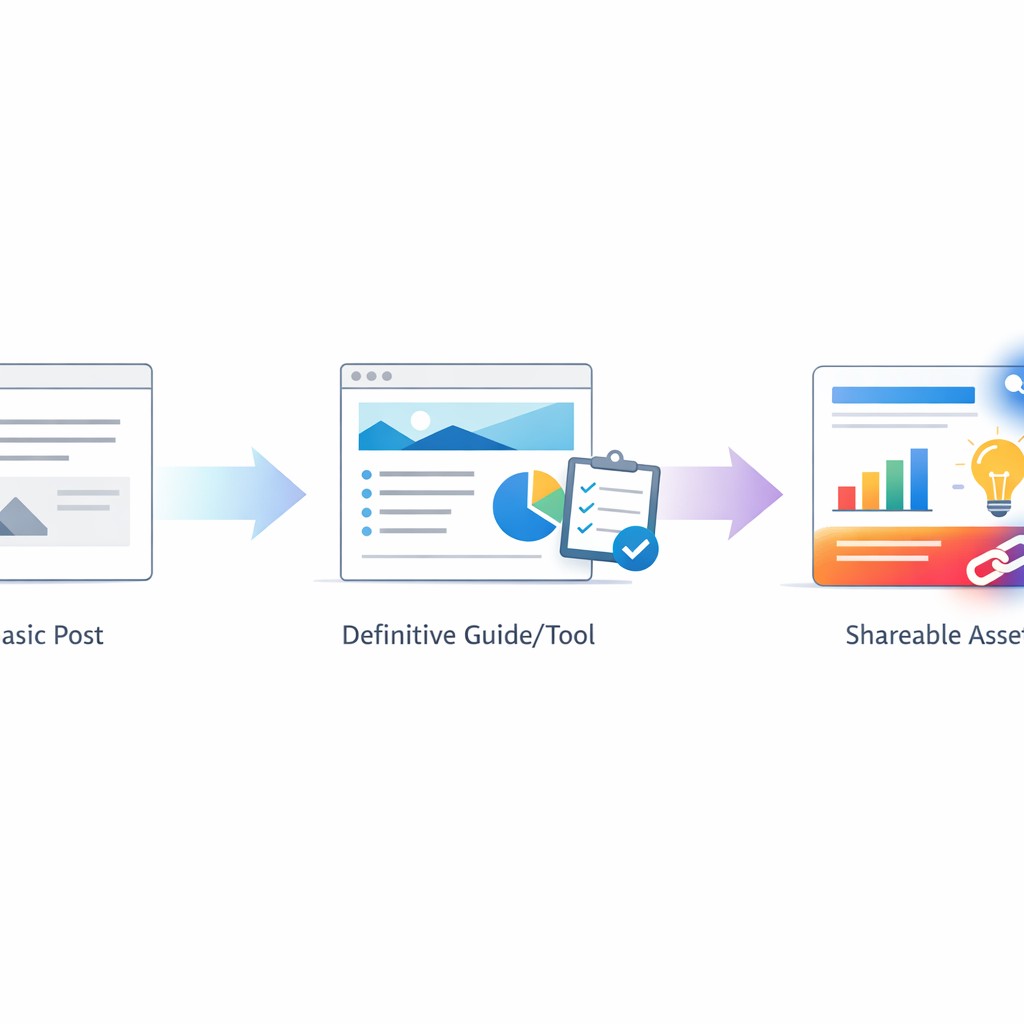
There are three core upgrades that change how your content plays in the world: make it definitive, make it useful, and make it frictionlessly shareable. None of these are theory. They’re practical shifts that take a piece from “another blog post” to the one everyone bookmarks.
First, don’t just cover a topic—own it. Definitive guides, detailed frameworks, and genuinely exhaustive resources become the web’s reference because they remove the need for readers (and writers) to hunt elsewhere. With definitive content creation, your work becomes unavoidable in your niche. Original data and free tools consistently get cited—combine both for a link magnet; people crave fresh numbers, and structured facts pull in links from people and even LLMs. Think about those classic textbooks that always get assigned or the spreadsheet template you see in a dozen Slack channels. When your work feels that inevitable, it compels links—often without you asking.
Utility is your next lever. Fill a gap by giving people something they can use right now: data nobody else has gathered, a calculator that answers a recurring question, a framework that saves hours. This isn’t just a one-off. Over time, assets like original surveys, how-to visualizations, or even simple downloadable tools keep getting referenced because they’re genuinely handy. Make your content part of someone’s workflow and it will keep surfacing in citations.
Shareability sounds minor but drives outsized results. Visual resources—like infographics, diagrams, or step-by-step frameworks—make it embarrassingly easy for someone to drop your work into their deck, slide, or post.
People share what’s already easy to share.
If a link, image, or embed code is ready to grab, your odds of distribution jump overnight.
Let’s be straight. The hard part is that this approach takes more up-front effort than regular content. You’re not just pushing out thoughts; you’re investing in assets that solve real problems or settle debates. Sometimes it means stretching beyond your comfort zone.
There are days when this feels a bit like cleaning out an old storage unit. I once spent a Saturday sorting through a pile of notebooks “just to organize,” only to find half-finished pages, sticky notes that made no sense—and, at the bottom, a hand-drawn flowchart from a project I barely remembered that ended up inspiring a much better template for a post months later. The process was a mess, felt pointless at times, and yet something valuable showed up by accident. Content is like that. You dig, assemble, hit a wall, question it, and sometimes what felt aimless unlocks exactly what other people need.
Build the resource everyone wants to borrow, and suddenly you increase backlinks to content, with your links, your tools, your frameworks circulating when people need answers, month after month. Over time, it stops being just your project and starts shaping the conversation much bigger than you ever could with one-off articles.
Reframing Content as an Investment—Not Just a Task
I get the hesitation—especially if you’re already maxed out and wondering if the payoff is worth the lift. It’s natural to question whether putting extra weight on a single article is smart use of limited resources. Honestly? I used to ask the same thing.
But here’s the shift. When you master linkable content, what you know doesn’t stay locked in your head or buried on your site—it turns into referenced assets that keep working. This isn’t just about feeling productive. Suddenly, your ideas travel further, pulling traffic and credibility you couldn’t buy with ads. It’s a lot like filing a patent or getting published in a respected journal. Your name and work become synonymous with the solution, and others point back to you when they need to prove a point or teach a concept.
The mechanics don’t need to be overwhelming. Start by picking an article that’s getting some search hits but rarely cited. Scan it for missing depth, gaps only you can fill, or places where an original chart or template would make someone else’s post instantly better. Think about adding your own data set, a simple calculator, or an infographic—step by step, you move it toward the kind of resource others want to link, not just read.
You don’t have to overhaul everything at once. A quick enhancement—a visual, a stats table, a downloadable worksheet—can turn something that’s ignored into something that’s cited, and the process only gets easier as you go. This isn’t a one-and-done project. It’s a cycle that compounds with every new asset.
So here’s my challenge. Audit just one article. Make an intentional upgrade and watch how even one change can open up new traction and recognition.
If you want to quickly turn your insights into an article that’s ready to share, try Captain AI and generate your first piece for free.
Truthfully, I still find myself slipping back sometimes—falling into the old pattern of pushing something out, ticking the “done” box, and hoping it’ll stick without added effort. I know the formula now, but I haven’t managed to make it second nature every time. Maybe that’s just how habits change.
Enjoyed this post? For more insights on engineering leadership, mindful productivity, and navigating the modern workday, follow me on LinkedIn to stay inspired and join the conversation.