Use Calls to Action to Boost Engagement and Results
Use Calls to Action to Boost Engagement and Results


The Real Reason Your Content Isn’t Converting (And How to Fix It)
You ever sit back and wonder why that blog, email, or LinkedIn post you spent hours (and a chunk of your budget) on just… fizzled out? Five likes, no comments, barely a click. Not for lack of trying—you crafted the story, the images, the snappy headline. Still, nothing moves. This happens more often than anyone wants to admit.
For a long time, I ignored the uncomfortable part: most of my posts, newsletters, all that outreach, would just drop off. No sign-off, no direction. Just a flat ending and a hope that readers would, somehow, know what to do next. They won’t guess what you want. Expecting them to is a recipe for silence.
Everything started to shift when I realized you need to use calls to action consistently—adding even a simple, explicit call to action at the end (“Drop a comment if you’ve been there,” or “Click here for the template I mentioned”) made a night-and-day difference. On weeks I skipped it, numbers dipped. But every single time I closed with a clear CTA, the interaction rate spiked hard. Saw HubSpot and marketing analytics research revealing huge CTA-driven gains; I watched those same jumps happen in my own metrics.
I’ll be honest, I used to kid myself that extraordinary insights or “valuable content” would be enough. Sometime last spring, I put out what I thought was my most useful teardown. Tons of effort, detailed graphics, even a list of next steps. But I ended the post with a vague “Let me know if this helps!” And predictably, nothing happened. No replies. The next week I scribbled down a basic “Reply with your toughest challenge—I’ll answer two.” Suddenly, conversations. The thing is, I spent more time tweaking color palettes than thinking about how someone would respond. Silly, in hindsight, but it happened. Anyway, back to the real point.
So here’s what’s actually happening: If you want to increase content engagement, remember your audience isn’t ignoring you. They’re just waiting for you to connect the dots. Strip out the ambiguity, and your content wakes up. A clear CTA removes the friction between attention and action—so your effort finally translates into real response.
Clarity, Not Hope, Is What Drives Results
371% more clicks. 285% higher engagement. 80% boost in conversions. All from three letters most content creators underestimate: CTA. That’s not marketing hype—it’s what happens when you shift from vague hope to direct request, and the numbers back it up. CTAs work because they leverage attention, emotion, and memory—standing out visually and matching the context is what gets them noticed and acted on.
Here’s what caught me off-guard when I started paying attention: not everyone will actually do the exact thing your CTA suggests. But just having that clear doorway at the end of your piece—“reply and tell me,” “download now”—is what tells people the conversation isn’t over. The presence of a CTA signals you’re open to interaction, not just broadcasting into the void.
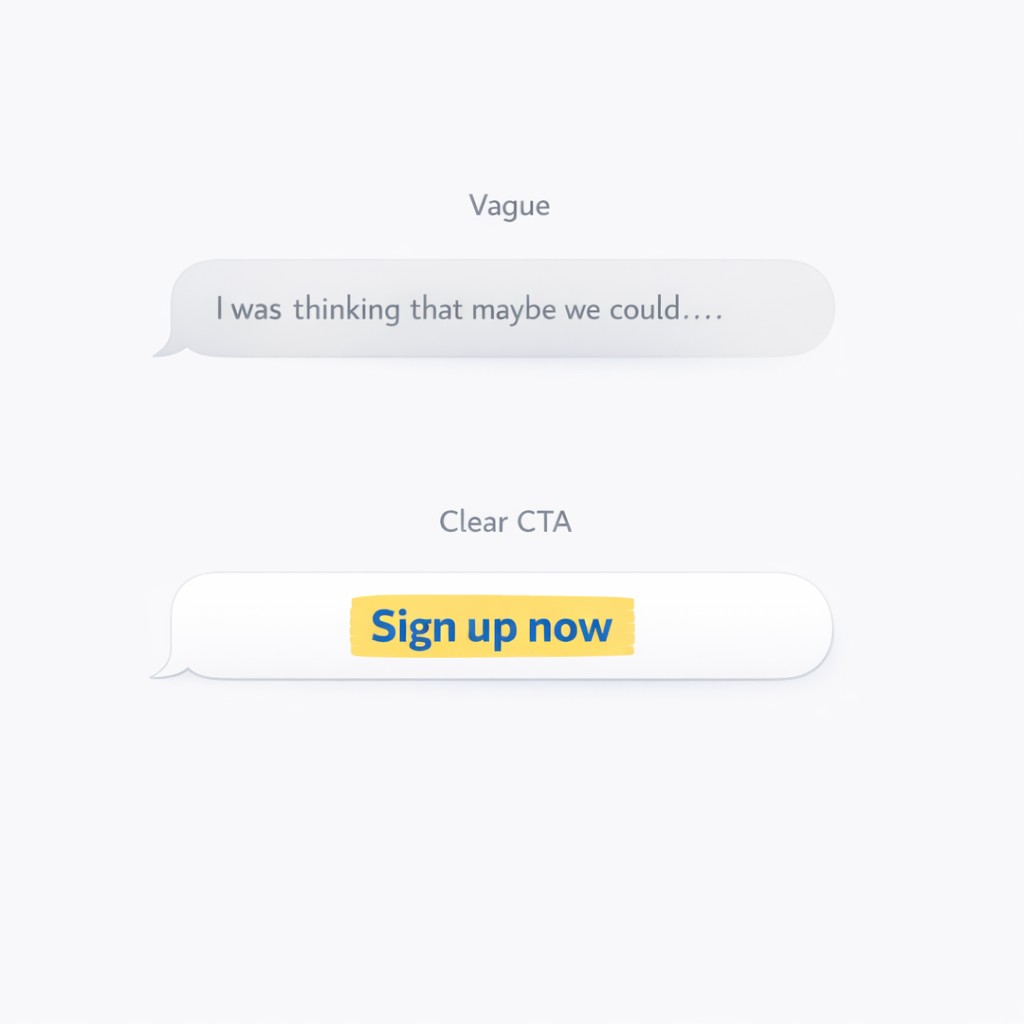
So here’s the fork in the road: every time you finish a post, an email, even a short DM, you can either leave the next step to chance—or intentionally shape that closing moment.
A CTA is you shaping that moment instead of hoping for the best.
Zoom out across formats—LinkedIn, newsletters, sales pages, even those “quick question” Slack messages—the pattern holds everywhere: clear beats vague. If your instruction is fuzzy or you close with “let me know your thoughts,” expect crickets. If you spell it out, you see action.
To be totally honest, I used to think CTAs were pushy, maybe even a little needy—until I watched the data and the actual responses pile up. Turns out, results speak louder than my old hesitation.
Use Calls to Action: Breaking Down the Anatomy of a Strong CTA
A good call to action isn’t complicated—it’s just specific, actionable, and right in sync with both your message and where your audience is at. That means you’re not tossing out a generic “let me know” and hoping it lands. Instead, you’re saying exactly what you want them to do (“Download your copy now,” or “Hit reply if this hit home”). Without a CTA, your reader might just interact and move on—across every channel, from blogs to emails and social, CTAs point people to the next step. This clarity is what separates a forgettable scroll from genuine engagement.
With effective CTA strategies, your CTA should show up right where people are most focused and just about to drop off—bottom of a blog post, end of a LinkedIn update, closing line of an article or video, or the last line in your emails, DMs, memos, or Slack messages. Meet attention with direction before it fizzles out.
Now, let’s not overthink it, you’re not begging—you’re helping them take the next step. You’re giving people permission to move forward, not shoving them through the door.
I’ll admit, adding CTAs felt a little awkward and even forced at first. But once you start paying attention to the way audiences actually respond, the upside tells its own story, and it’s hard to argue with better results.
And here’s the positive flip: a content call to action isn’t about demanding a sale every time. They’re just about opening a door—to more feedback, a share, a click, even a simple reply. That’s where real engagement starts, and it’s all you need to keep momentum building.
Even now, I sometimes catch myself writing right to the end and pausing, unsure what “ask” fits the tone or audience. Sometimes I still leave it off, betting the content will carry itself. Hasn’t paid off yet, but maybe there’s some exception out there I haven’t seen.
How CTAs Turn Content Into Results—And What Happens When You Don’t Skip Them
A clear CTA means you improve audience response because your audience isn’t forced to read your mind. You cut out the second-guessing, remove that fog of “what now?” and build actual trust with your readers. This is about clarity, not cleverness.
Here’s what it actually looks like. Choose a single, focused CTA and the numbers aren’t shy: zeroing in on a single CTA can boost clicks by as much as 371% and send sales soaring by over 1600%. Whether it’s more post comments, a jump in email replies, extra DMs, or lead forms filling up—this one lever pulls the weight.
I’ll be upfront with you, it took me longer than I’d like to admit to treat CTAs as non-negotiable. A little over a year ago, after sifting through a messy analytics dashboard, I saw it—every piece with an explicit next step reliably outperformed everything else on both reach and response. Not just once or twice, but week after week, across different channels. What seemed minor—a single sentence at the end—compounded into more momentum, richer conversations, and yes, real measurable growth. It’s the one habit shift that’s paid out every time.
Sometimes, the responses I get aren’t perfect. They go off-topic, miss the intent, or just show up as a question I didn’t expect. But even that uptick in activity is proof the audience is awake and invested. I recognized the pivotal moment at the end of every piece of content, where the CTA shapes reader action. Imperfect engagement is still a feedback loop most creators only wish they had.
So here’s my challenge: on your very next post, email, or DM, embed a clear, intentional CTA. Pay close attention to what shifts, even if it’s subtle. You’ll learn more from paying attention than from any guide.
Make It a Habit: Turning CTA Insight Into Lasting Advantage
Let’s get something straight—adding a CTA isn’t some heroic, one-time action. Results show up when it becomes automatic, built into every outreach, update, and follow-up you send. Consistency is the advantage most people overlook.
Start with a quick scan of your last few posts or emails. Notice which pieces trailed off without a CTA and compare them to the ones where you actually guided your audience. That side-by-side is the kind of pattern you can’t unsee—and it’s how you spot missed momentum, not just missed clicks.
Here’s the part that reframed it for me: every time you guide someone clearly, you reclaim wasted investment and unlock real interaction, measurable improvement, and ensure your content is truly impactful. Your effort deserves that payoff.
Ready to see a clear, actionable CTA in practice—use Captain AI to quickly generate your next article for free and experience real engagement without the usual wait.
So, here’s your next step: try ending your very next piece with a CTA—then just notice the difference. Share what happens. That’s how the habit sticks.
Enjoyed this post? For more insights on engineering leadership, mindful productivity, and navigating the modern workday, follow me on LinkedIn to stay inspired and join the conversation.