How to Build Defensible Products When Shipping Is Cheap
How to Build Defensible Products When Shipping Is Cheap


Don’t Ship Everything AI Lets You Build
Last Sunday, a friend—sharp, always ahead on the new stuff—asked me something that stopped me cold. He’s been cranking out projects with Claude Code at a pace I didn’t think was possible until now. “If I can build any app in a weekend,” he said, “should I just ship every idea?” I laughed, a little jealous, more than a little impressed. The feeling that we’re living in a sped-up timeline is real—this level of velocity wasn’t here six months ago. It’s like someone yanked the brakes off the process for everyone who knows what to ask.
With Claude Code, it feels almost silly not to build everything that floats through your head. The technical bottleneck is gone. If you can describe an app, you can probably see it working in a couple of days. My first instinct was to say yes. Who wouldn’t want a portfolio of shipped apps to show off? But I caught myself, because I know what happens next.
The old rule was “if you can build it, do it.” That’s over. Shipping fast is now the baseline. Speed alone can’t protect your time, your energy, or your product. When everyone gets good at implementation, what actually sets a project apart? Shipping is now just the ticket to play. What matters is how you filter what’s worth playing. Differentiation—making something that only you can or will do—is the new foundation. Here’s the tricky part. Most apps built on pure speed end up looking the same, fighting for air in a crowded room. Without a better filter, shipping fast becomes just another way to waste months.
So this time, I didn’t say yes. What I did: I ran every idea through four filters—the starting point for how to build defensible products—I wish someone had handed me before my own AI sprint. The ones that stick have a distinctive solution, a real intention to keep operating them, a clear path to actual paying users, and some moat that lasts even when AI and speed are everywhere. If you recognize yourself in the urge to ship everything, stick around—I’ll show you how to use these filters to protect your time and build something that stands up later.
Why “Can You Ship It Fast?” Became the Wrong Question
It used to be that getting a working product live in a weekend felt extraordinary, something that really separated serious builders from the rest. That’s changed. When developers with tools like GitHub Copilot report finishing repetitive tasks significantly faster, speed stops being an advantage and just becomes the default. The whole game tilts. It’s not about whether technology lets you build. It’s about what you actually choose to invest time in now that building is easy.
If you want to create something that outlasts the feature race, shipping speed isn’t your lever anymore. Instead, you need four things for defensible product differentiation: a unique solution (not just another spin on the same idea), a genuine intention to maintain and improve it, a route to users who pay and stick around, and a moat that endures even now that code speed isn’t special.
I’ve seen firsthand that the honeymoon with these tools is real but short-lived. Nonstop hands-on use of Claude Code across multiple projects revealed how fast features can ship. But after those first wins, maintenance debt creeps in. Gaps in polish start to show. The projects that shipped quickest are often the ones that need the most work—usually at the worst time.
I keep telling myself I’ll set up a process to stay ahead of updates and bug fixes, but more often than not, I’m chasing fixes after the fact—and it’s usually just as I’m about to demo something. That hasn’t changed, no matter how quickly the initial build goes.
This is why you need to start filtering every idea through those four lenses before you write a single line of code. Hear me out. Your energy, your attention, and your time are scarcer than any API call. Filter hard now, and you’ll end up with something that survives the next wave and actually gets better as you go.
The Four Filters: How to Build Defensible Products That Endure Even When AI Levels the Field
When I reviewed my friend’s running list of weekend-ready app ideas—the ones AI makes almost trivial to prototype—I started spotting a pattern. The concepts that stuck with me—the ones that felt as if they could have a real shot—mapped directly to how to build defensible products, always clearing four non-technical checks that AI alone can’t automate or accelerate. It’s funny. The logic seemed obvious only after we actually named these filters out loud. Until then, it was just a vague sense of déjà vu from past projects that faded out too soon.
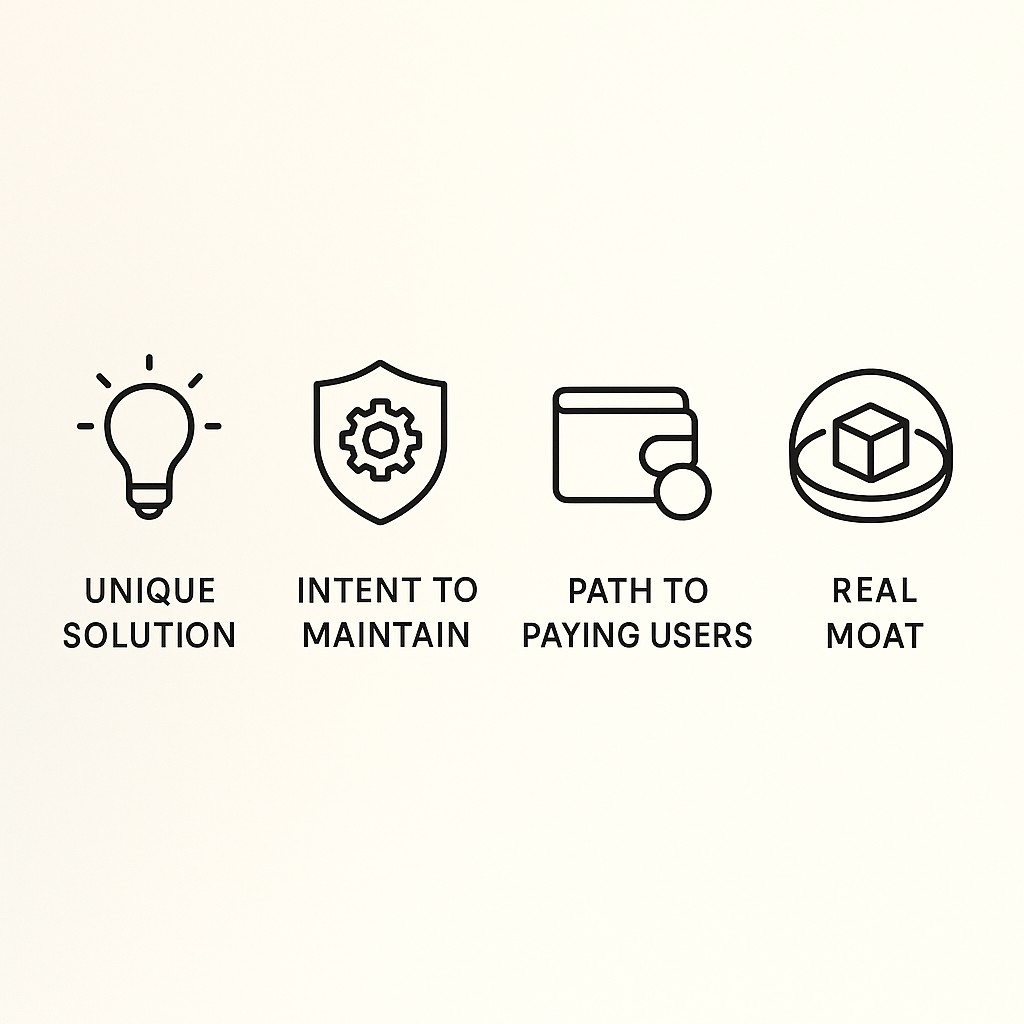
The first filter is having a distinctive solution. These days, “I built it in a weekend” isn’t a differentiator. Half of Twitter can claim that on Sunday night. The only things that stand out now are solutions with a direction that’s meaningfully different from a wall of look-alikes. Think about tools layered on top of the same open APIs.
If your product’s only advantage is “being first” or “being fast,” you’re a sitting duck. What matters is unique framing or execution. A data viz product that automatically surfaces hidden relationships instead of just making dashboards. Or a niche vertical workflow that solves headaches generic tools gloss over. The technical lift—a good prompt, an API call, maybe some glue code—is less important than whether you designed an experience or approach users won’t see ten more times this quarter.
A quick test I use here. If a stranger can’t sum up how your app’s approach is different in one sentence, you’re working on a commodity. That might get you launched, but it won’t help you avoid commodity app ideas or get lasting traction.
Next up is intent to maintain. I’ve learned (the hard way) that unless you’re willing to carry a project through bugs, feature requests, and the five-alarm customer emails that come once the shine wears off, there’s no point starting. Customers will always complain. Products break—sometimes right after launch, sometimes at 2am. Support never ends; it just cycles between chill and crisis. Only ship what you can see yourself supporting, evolving, and defending after the exhilarating “new project” feeling disappears.
Not to get melodramatic, but I’ve been there. Wrestling with a bug in the dead of night, it felt exactly like biking up a steep hill and hearing my chain snap. I got home, but only because I had tools taped under my seat—tools I’d bothered to pack ahead of time.
Third, you need a path to paying users if you plan to monetize and sustain products. Who actually puts money down for what you’re building, and why would they pay now, not six months from now when five clones exist? Can you reach them, and do you have a way to test their interest before sinking weeks into polish? The fastest way to reality-check an idea is to get a stranger to commit—even a token payment or a pre-order—before you write another line. You don’t need a whole go-to-market plan up front, but hand-waving “someone will pay for this eventually” isn’t enough. Sketch out the channel, the segment, and your wedge. It’s a litmus test for commercial viability that saves so much wasted time upstream.
Then there’s the fourth and final check. Does your idea have a moat beyond AI or speed? That is, could you keep a lead even after the next dozen projects build the same thing, just as fast? Moats aren’t about secret prompts or faster code anymore. They’re about distribution (who do you already reach?), unique relationships (partnerships that others don’t have), proprietary data you own or generate, deep integrations into customer workflows, or a brand people trust. Here’s the reframe: AI isn’t a moat. It’s table stakes. If your edge depends on speed or your use of a public model, you’re building on sand.
Durable advantage comes from the machine around the model—the routines, partnerships, and operating rhythm you set in motion. Long-term defensibility relies on vertical expertise, sharp GTM, and world-class teams, not just packaging new tech, while data or ML alone doesn’t guarantee real barriers. The product isn’t just the AI. You build systems that last.
For me, honestly, it’s not that I use AI to power my content systems—anyone with Claude Code can slap together similar scripts. My edge is that I’ve removed all the friction from building and running a content network at scale. That infrastructure—and how I keep it humming—sets me apart, not the flashiest model behind the curtain.
Using the Filters: From Idea to Enduring Product
Before you hit ship on that next Claude Code weekend build, use these four straight-up questions to choose defensible product ideas. Is this solution actually distinctive? Do I care enough to maintain it? Is there a path to paying users? And is there a moat here that holds up even if everyone else builds as fast as I do?
Let me show you how this plays out with something real. Imagine you just whipped up a Claude-powered tool that schedules social posts across platforms—classic “done in a weekend” territory. Here’s the filter: Distinctive? Not really; similar schedulers are everywhere. Maintenance intent? Maybe, until the third API breaks. Path to paying users? Maybe if you nail one vertical, like realtors or authors. Moat? Unless you hook into niche CRM systems or deliver insights from unique, privately-held datasets, you’re toast. So unless you push this out of commodity territory—say, by integrating with hard-to-reach channels or tailoring it to an audience nobody else thinks about—you should pause or go back to refine.
That chain-snapping moment from the last section? It’s exactly what you’ll feel if you commit to shipping without actually filtering for maintenance and differentiation. The tools get you up the hill fast. They just don’t patch the chain for you when it breaks.
If you want a moat that lasts past the launch tweet, make your product moat strategy about playing where others won’t or can’t follow. Pre-sell to a small group that truly needs what you’re building, even if it feels too specific—it’ll get you genuine feedback (or cash in hand) before you’re tempted to overbuild. Integrate with services most others can’t be bothered to wrangle—industry-specific APIs, legacy systems, or local data troves—because that friction keeps copycats out. Collect data nobody else has or can replicate, and use it to deliver results that generic tools just can’t match.
And most overlooked: build in community support loops, where your users help each other or generate referral momentum. That sort of flywheel isn’t a generic “network effect.” It’s a slow-burn moat that’s hard to detach once it starts turning.
Here’s the hard line I draw now. Only ship ideas that clear all four filters. Quick builds and experiments? Use them to learn or sharpen instincts, but don’t treat them as products until they stand up to the checklist. Protect your time. Save your launch energy for work that endures.
There are still weeks where I ignore my own filter and chase a shiny app idea for no other reason than I want to see it live. I know it’s not defensible, but sometimes curiosity wins over discipline. I haven’t figured out how to shut that impulse down for good.
Get quick, on-brand drafts, summaries, and repurposed posts with our AI content app, so you can test positioning, share progress, and gather feedback while you reserve build time for ideas that clear your filters.
Facing the Fears: Why Filtering Saves More Than Just Your Time
If you’re worried that stopping to apply filters means watching opportunities slip away, I get it—I had the same anxiety at first. Ironically, it felt like slowing down just as the world sped up. But here’s the truth. Taking an hour to run an idea through clear checks isn’t paralysis—it’s protection. That focus can save months you’d otherwise spend fixing, redesigning, or maintaining projects you shouldn’t have shipped in the first place. It’s like laying out your tools before starting a build, not stalling the process. Framing cuts down the back-and-forth, which means you actually avoid wasted cycles, not add them.
It’s natural to fear missing the AI wave. I felt the same rush last spring, when every new model felt like a ticket to jump ahead. Speed absolutely helps you explore, test, and learn. But the easy wins fade fast. What actually lasts is the system you build around your product—clear structure, support, and feedback loops—not just the model or framework you choose. The honeymoon phase? It’s real, but it’s short. Once the initial excitement ends, you’re left with what you built to stand up over time.
So here’s my commitment, and the direct advice I pass to you. If building is cheap and launch is fast, only ship the ideas that clear all four filters. Hold your line for projects with defensible differentiation, and let experiments stay experiments.
Enjoyed this post? For more insights on engineering leadership, mindful productivity, and navigating the modern workday, follow me on LinkedIn to stay inspired and join the conversation.