Increase Domain Authority Naturally: Earn Trust That Compounds
Increase Domain Authority Naturally: Earn Trust That Compounds


The Lure of Shortcuts—and the Gut-Check That Stopped Me
I was one click away from spinning up a pack of satellite sites for easy backlinks. This wasn’t a passing thought—I had the hosting ready, WordPress installs queued, the whole plan mapped out. Even now, I can feel how badly I wanted to move the needle, fast.
But then a peer—someone whose opinion I actually trust—just asked, deadpan: “What do you think about this satellite strategy?” The question made the friction snap into focus. Not the clever efficiency I’d talked myself into, but a deliberate sidestep. There’s a difference between leverage and baiting the system, and I was staring straight at it. The honest answer? I knew exactly what I was doing, and I was hoping nobody would call it what it was.
That’s when I stopped. Before Google could. I didn’t want my work to hinge on hiding tactics instead of building proof.
Still, the struggle is real. If you need backlinks for SEO, and you need SEO to get backlinks, how do you get enough traction to break the chicken-and-egg cycle? It’s not just you, not just me—every founder I talk to has faced that desperate catch-22. The paradox is seductive: a manufactured shortcut looks like progress when the “right way” feels impossibly slow. Next thing you know, you’re neck deep in tactics you’d never recommend publicly, chasing numbers and hoping it all counts.
Here’s the uncomfortable truth. When backlinks are the hardest part of SEO, shortcuts start looking smart. But the compounding value is in earning trust, not gaming detection. Let’s talk about what actually works if you want to increase domain authority naturally.
Why Chasing Traffic Isn’t Authority—and Where We Get Stuck
Here’s where things usually go sideways. It’s too easy to start believing attention equals endorsement, or that a flood of visitors must mean search engines see you as valuable. Just to put a fine point on the distinction—user data from Chrome isn’t on the table as a ranking factor, so traffic ≠ authority. Having a spike in clicks feels good, but on its own, it won’t move your link profile or your rankings. They really are different currencies.
Authority, in Google’s eyes, isn’t about how many people show up—it’s about which sites are willing to vouch for you with a backlink. To the algorithm, every legitimate link is a third-party vote of confidence. Viral doesn’t mean trusted. Reputation is about references, not reach.
So grab a sheet of paper and draw a line down the middle—one side for work that brings traffic (think paid ads, social posts, PR stunts), the other for real authority accelerants (things that attract hard-won backlinks). You need both, but they don’t operate the same way. Get clear, and strategy gets a lot less murky.
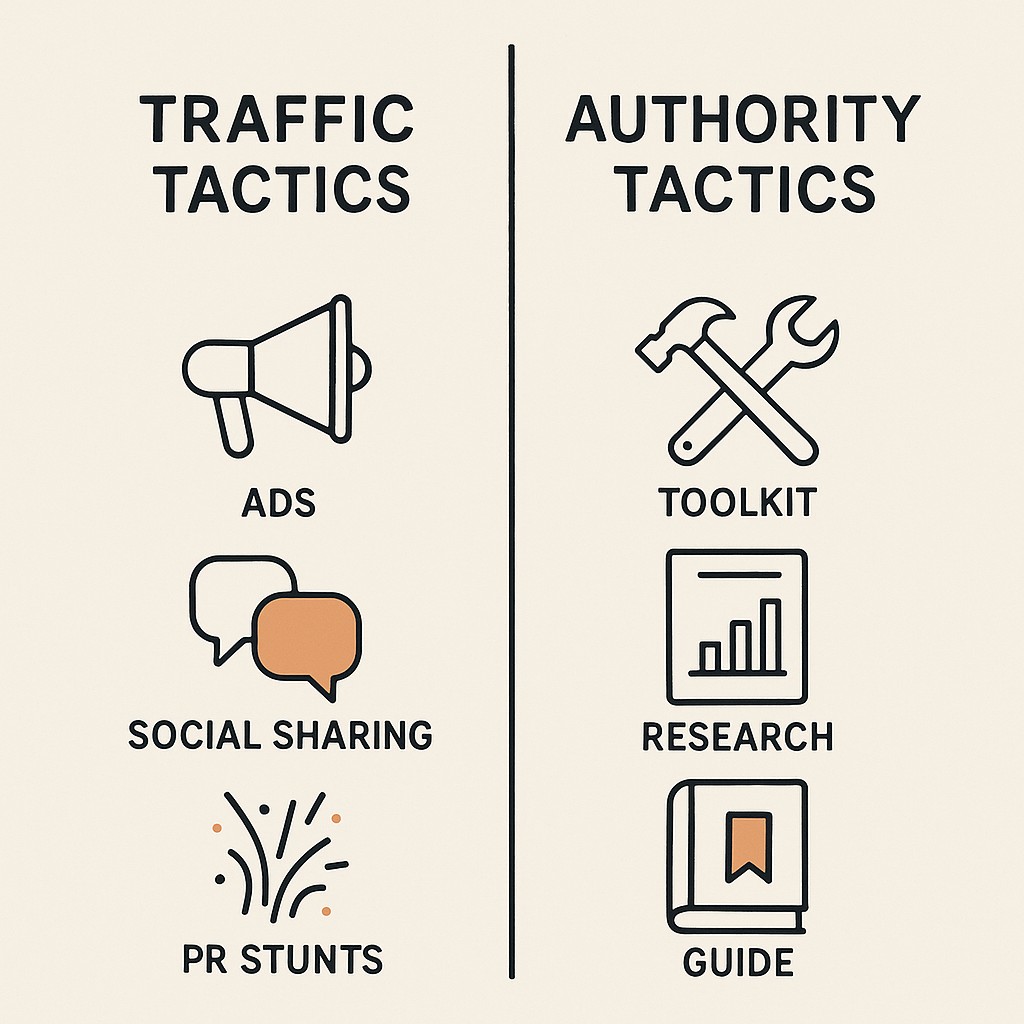
Six months ago—I was still falling for the idea that attention alone would somehow grow my reputation. If I’m honest, I misread the early advice too. “Just get pages that go viral,” they said, and I spent weeks cranking out whatever might get clicks—without asking if it would ever be cited or referenced. Only later did I realize most of that guidance hinges on evasion. It’ll work as long as you avoid Google detection. Which isn’t a strategy. Just a countdown clock. The day you mix up traffic with authority is the day you risk burning time, or worse, burning trust.
Mapping the Shortcut Spectrum: How to Spot Risky Tactics Before They Cost You
Shortcuts aren’t just one tactic. They run a whole spectrum, so learn to avoid backlink schemes ranging from building satellite sites and link farms to outright buying links, dumping your domain into spam directories, mass forum commenting, or cranking out irrelevant guest posts. Each one is a different flavor of the same thing: trying to manufacture authority signals, hoping they’ll pass for the real deal. If you keep an eye out for patterns instead of just isolated tricks, you’ll start noticing how these schemes cluster—unnatural connections, mass scale, and links completely separated from actual relevance. It’s rarely just one “shady” move. A shortcut mindset tends to show up across the board.
The fallout is bigger than it looks upfront. When a site gets hit by an algorithm update, you could be looking at 3–6 months or more of recovery time—if you recover at all. That’s not just a lost week. That’s quarters in the red, momentum stalled, sometimes a business set back years. Google’s memory for this stuff is longer than yours or mine.
This just reminded me—one afternoon maybe eight years ago—I was at a café trying to rewrite a product page for the fifth time. Instead of doing the real work, I ended up looking at cheap Fiverr gigs for backlinks, in between bites of a cinnamon scone that was honestly dry, but I’d bought it so I kept eating. I never ordered from those gigs. I did waste the afternoon justifying the possibility. It’s odd how the tactic always felt easier than actually fixing my offer. In hindsight, that old scone sums up shortcut logic better than any penalty warning; it seemed like a solution, but mostly it just left me with regret and a sore jaw.
Here’s a confession. Years ago, I tried using a “quick win” hack in a totally different part of my professional life. It worked until I had to explain it to a colleague—and the silence that followed told me everything. Shortcut logic never holds up when you say it out loud.
Want a fast gut-check for SEO shortcuts? Start here. If a tactic promises easier or faster links but doesn’t pass a basic relevance or value sniff test, treat it as a red flag. Run site:yourdomain.com in Google and examine your top referrers. Are you seeing a bunch of no-follow links from LinkedIn, social media, or affiliates who are only connected to you by marketing relationships, not genuine interest in your content? That’s a symptom, not a strategy.
Same if all your guest posts have nothing to do with your core topics, or if you’re listed on a directory you’d never actually use yourself. If you could swap your site’s name for anyone else and the link would “work” just as well, it’s probably a shortcut dressed up as hustle.
All this mapping wasn’t just academic. Pinpointing the spectrum of shortcuts is what finally pushed me to redirect stubborn effort into real authority work. Shortcut tactics burn out. Invested reputation compounds. And now, instead of worrying about what I’ll say in the next peer review, I’m seeing durable progress—the kind that’s not just visible in rankings, but in trust that actually lasts.
How to Stop Chasing Shortcuts and Increase Domain Authority Naturally with a Site That Attracts Real Links
Let’s just call it plainly. If you’re spending hours figuring out “systems” for building links anywhere but your main site, you’re already doing hard work—the direction is just off. Imagine if you took all the hustle you’ve poured into workarounds and instead funneled it into a linkable assets strategy that actually makes people want to cite or reference you. That’s leverage. Not only are you staying out of the penalty box, but you’re building a foundation that doesn’t evaporate when the next algorithm update rolls in.
Here’s a framework I wish I had tattooed on my hand during my shortcut phase. Traffic channels are the obvious plays—social posts, paid search, digital PR, moves designed to get eyeballs, not necessarily links. Authority assets are what actually help you earn backlinks naturally: standout tools, original studies, in-depth explainers, or resources people naturally want to cite. Think of traffic tactics as pouring water on your site. Authority assets are the well, quietly filling up over time.
So, what’s the actual move? Start by getting very clear on your audience’s hardest questions—the ones that keep surfacing in communities and forums, but rarely get a satisfying answer. Build something so specific and useful around that pain point that when someone finds it, their first instinct is “I have to show my team this.”
You don’t need to invent a new content type; just deliver on clarity, depth, or utility at a level that stands out. Then, when it’s live, don’t just post and pray—share it thoughtfully with peers who write about related topics, reference it in your own posts, and surface it (ethically) wherever your audience already hangs out. This isn’t about mass-blasting emails or dropping links blindly; it’s a cycle of contribution, not extraction.
If you’re willing to make this pivot to build site authority naturally, here’s the upside. You’ll leave here able to spot shortcut tactics before they cost you, finally untangle traffic from authority, and reorient your daily moves to build a site people naturally want to reference. The patches you’d waste keeping scammy links hidden? That’s time you can put into genuine authority—the kind that sticks, survives updates, and builds a brand people trust.
If you need a solid first draft for domain authority without spam, Captain AI will generate a focused article for free, saving hours you can spend earning real backlinks.
How to Know Authority Is Compounding—and Why It’s Worth the Wait
Let’s be honest. Slower results are frustrating, especially when you’re measuring your effort week to week. If the fear is that this takes too long, or that your competitors might pull ahead while you’re playing the long game, you’re not imagining things. I’ve been there, too. Second-guessing if this patient slog will ever pay off.
But here’s what you can actually track. If you’re seeing your backlink profile grow by 5–14.5% in new referring domains each month, you’re on a compounding authority path worth tracking source. That’s the early signal—not a viral spike, not just traffic—that your site is starting to earn organic trust. The “compounding” part is key. As those quality domains accumulate, not only does your baseline authority lift, but new links get easier over time (other sites see you as a reference, not a risk). This metric cuts through noise and helps you know when to keep investing.
So let’s draw a clean line right now on how to increase domain authority naturally. Are you chasing tactics that could get you in trouble, or are you allocating effort where it will compound? If “manufacturing” links still eats up cycles in your calendar, stop. Redirect those hours into content, tools, or resources so useful even a skeptic would want to share them. With every fresh backlink earned the hard way, you’re building something that survives the next update, the one after that, and so on.
Here’s where I net out. Shortcuts promise speed, but the effort they soak up is rarely recoverable—and it always requires more patching, more hiding. Invest that same energy in genuine authority work and you’ll own outcomes no competitor can fake. I stopped myself before Google could stop me. That decision is still compounding trust today.
And if I’m being real, after more than 25 years trying to outthink systems—there’s still part of me that scans for the “quick fix” every time something stalls. I know better, but some habits don’t fully disappear. Maybe that tension is the real price of durable authority; maybe it’s the reminder I need to keep choosing the slower, stronger path forward.
Enjoyed this post? For more insights on engineering leadership, mindful productivity, and navigating the modern workday, follow me on LinkedIn to stay inspired and join the conversation.