Reduce Software Ownership Burden: Why SaaS Delivers Lasting Value
Reduce Software Ownership Burden: Why SaaS Delivers Lasting Value


The Fast Build Trap: Where AI Speeds Up, Ownership Slows Down
I spun up a chat app this spring. AI handled everything from the data model to the UI—no drama, just prompts and code, all buttoned up in what felt like an afternoon. But getting it ready for the real world? That’s where the illusion broke. Suddenly, I was tangled in cloud configs, CI/CD pipelines, security policies, and the ballet of connecting six different services so nothing fell over in production.
Honestly, I loved the rush at first. AI made it feel like the tedious parts of software were gone—type a few specs, watch the application take shape, skip weeks of grunt work. But the “build it quick” story is only half true. What caught me off guard (even after years in SaaS) was how the excitement vanished, replaced by new headaches: tracking permissions, updating dependencies, plugging security holes that weren’t obvious at all.
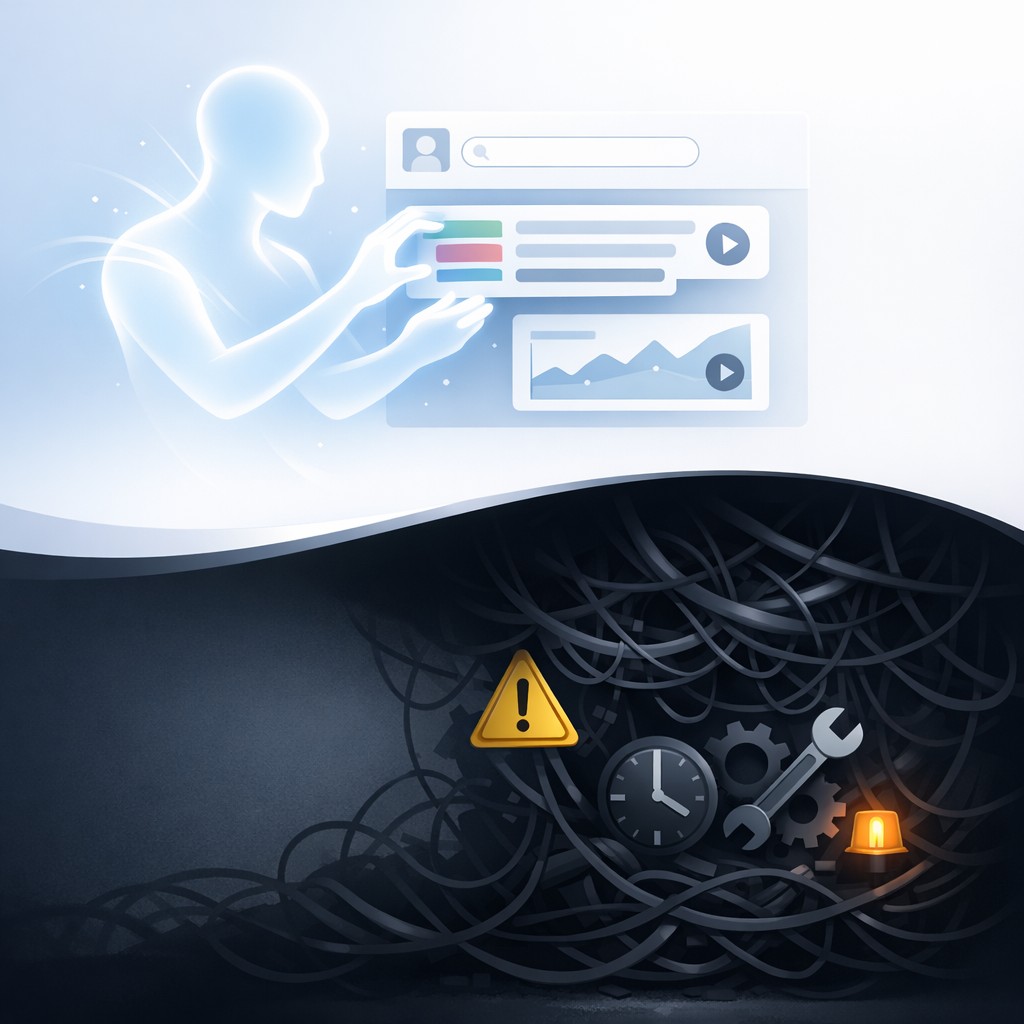
People obsess about how fast you can build now, but build time was never the real cost. The hidden costs of software come from ownership. Maintenance can end up swallowing 40% to over 90% of total software life cycle costs—which means keeping something running usually dwarfs the price tag of actually building it.
If you’re considering your own solution—maybe another AI-powered dashboard, or some custom internal tool—don’t think this is a fluke. Anyone ambitious enough to build will eventually face the challenge of how to reduce software ownership burden as they slam into these same post-launch walls: upkeep, compliance, break-fix, and yes, everything you never expected to own. It’s not just a technical detail; it’s the real price tag.
The Invisible Work After Launch
When you build it, you inherit it. And that costs something AI can’t automate away yet—your attention. The launch is never the end. Instead, you’re on the hook for a rotating set of jobs: fiddling with cloud service configs, tightening security groups, setting up rolling backups, and watching logs for suspicious blips that could be compliance headaches down the line. Nothing stands still. The stack updates, libraries age, and software maintenance challenges pop up constantly as eventually a customer pings you at 8am because something “just stopped working.” Every system needs this, and none of it is glamorous—cloud uptime, security patching, log review, SLAs, and the endless cycle of troubleshooting. These are the jobs that don’t disappear, no matter how you built the tool.
There are weeks it feels like all I do is chase down obscure errors. Last month, for example, I spent the better part of a Sunday debugging a permissions issue that turned out to be a single unchecked box in a buried admin panel. I’d nearly convinced myself it was a network problem. Two hours of scrolling through documentation later, one click fixed everything—though by then I was already questioning my life choices. This kind of thing never makes it onto the roadmap, but it quietly eats the margin out of your schedule.
Here’s where I admit what I hadn’t said out loud: I kept wishing AI would handle all of that, too. Six months ago, I really thought productizing with AI would mean less busy work after launch. But the work doesn’t really vanish; it just shifts from “building” mode into “maintaining” mode. I’ve coded myself into this corner enough times to know you’re just trading toolkits, not responsibilities.
Building a tool sometimes feels like snapping together flat-pack furniture. It’s all quick cuts and promises—“You could have this up and running today!” Getting it upright is satisfyingly fast with the new batch of AI co-pilots. But the fun stops when you’re the one living with the wobbly shelf, tightening screws every few weeks, and realizing the manual didn’t warn you about left-handed bolts. That’s the true project: adapting, correcting, and reinforcing so it doesn’t collapse on a Monday morning when you least expect it.
The real cost isn’t just dollars billed or hours logged—it’s the ongoing deficit in your own focus. Every new tool you build quietly stakes a claim on your brain, scattering your attention across context switches, half-finished upgrades, and nervous late-night checks. Most leaders underestimate that endless, background drag—and it’s exactly why those “quick wins” can end up so expensive in the long run.
Why SaaS Still Wins: It Helps Reduce Software Ownership Burden by Absorbing the Hidden Hard Parts
If you’ve ever looked at your SaaS bill—maybe for a bloated project management tool—and thought, “Why pay for this when our dev team could spin up the same features in a day?” you’re not alone. I fall into that trap too, especially when every new AI prototype feels so quick and tailored. We love the idea of building lean, of cutting out the middlemen.
But here’s the thing: SaaS survives because it absorbs what’s genuinely painful to own. The glamor fades fast after V1. The real grind isn’t writing the first feature, it’s making sure it keeps working for everyone, all the time. SaaS takes the pain out of reliability for you—updates, maintenance, and security patches land automatically, so you’re always current without lifting a finger, which are the benefits of SaaS that make ownership so much easier. It’s not just about pushing features—it’s the integrations, the support, the “it’s 2am and things still work” peace of mind. That’s what we actually pay for, even if we don’t always admit it.
Think back to that chat app. I built the MVP in hours. Shipping it to friends was easy and fun. But scaling it up? Suddenly it wasn’t about prompts and code anymore—it was about trust, uptime, and debugging an integration when Slack’s API changed with zero warning. That’s where SaaS feels less like a luxury and more like a shield.
And this is the part that’s easy to overlook: speed of build isn’t the reason SaaS wins. Convenience is. Stability. Not having to think about which library quietly broke last Wednesday, or whether a new security patch slipped by. People have always paid for convenience. That doesn’t change just because AI makes building easier. In fact, the more trivial building gets, the more those “invisible” layers of upkeep are worth.
The Advantage SaaS Builds That Custom Can’t
There’s a subtle but massive gap between “building your own tool” and “building a whole ecosystem.” When you go custom, you get exactly what you asked for—your features, your business logic, your UI. But you lose what SaaS delivers without even trying: a web of external integrations, plug-ins, and a live community of users pushing the boundaries and finding edge cases faster than any individual could. Network effects can’t be replicated. Even if you stitch together a few APIs, you’ll always miss out on the avalanche of improvements that happen when thousands of users try, break, and extend a platform in every direction. The real value isn’t the software—it’s the conversations, the integrations, and the collective experience.
But there’s something even deeper: the ‘data flywheel.’ Once a SaaS platform gets momentum, it doesn’t just gather users—it gets smarter and more valuable as those users pile in. Here’s what accelerates platform advantage: data gravity turns huge datasets into magnets, pulling in more apps, integrations, and value—which is why SaaS can compound its advantages at scale. You can rebuild the software. You can’t rebuild the users, the integrations, or the data flywheel. These compounding effects mean even the simplest SaaS tool can outpace its custom-built cousin—not because its code is better, but because the collective inputs keep making it smarter, faster, and easier to connect.
If you choose to go fully custom, SaaS vs software ownership becomes clear: you’re the one responsible for every integration point and workaround. There are no free rides here. Every missing plug-in, every API update, every “desired” data exchange—it lands squarely on your plate to build, monitor, and maintain. That’s not just extra effort; it’s a permanent job, not a one-time project.
And honestly, I haven’t figured out a perfect system for deciding where that line should be—the line between custom and buy, build and rent. Some projects feel worth the maintenance, others don’t. I still catch myself thinking, “Maybe this one will be different.” Usually, it isn’t.
How to Weigh Ownership Against Control—and Keep Your Focus Where It Matters
When you’re deciding whether to buy into a SaaS solution or roll your own tool, make sure your checklist covers the stuff that’s easy to ignore. Don’t just compare the feature list or the price tag. Put hidden ownership costs front and center.
Who’s on the hook when something breaks? Can your team really keep up with the relentless patch cycles, data protection updates, and compliance surprises? Will you inherit another technical distraction every time your stack shifts? Think about the burden—not just the build—and ask yourself: “Is this solving a real problem, or creating a new one for later?” These are the questions that cut through hype and target the decision that matters: which path really protects your focus, and which quietly increases your workload.
Let me be blunt. Investing in focus and freedom isn’t weakness—it’s strategic. There’s strength in knowing when to hand off, in choosing not to own every piece. Leaders who buy well aren’t just buying convenience; they’re buying back time, bandwidth, and the space to grow. It’s a move that respects your attention rather than squandering it on technical upkeep. You don’t have to justify it. In fact, you should be proud of it.
If you’d rather spend your energy sharing your expertise instead of wrestling with the fine print of software ownership, you can use Captain AI to draft a tailored article for free in minutes.
I come back to that chat app because it’s a perfect warning shot. I thought speed was everything, but the real lesson was about how attention gets chewed up. If you feel blindsided by invisible work, you’re not alone. Take a second: where else might hidden costs be stealing your focus, right under your nose?
Enjoyed this post? For more insights on engineering leadership, mindful productivity, and navigating the modern workday, follow me on LinkedIn to stay inspired and join the conversation.