SEO and Conversion Content Audit: Operate on Health and Relevance to Compound ROI
SEO and Conversion Content Audit: Operate on Health and Relevance to Compound ROI


Why Ranking Isn’t Enough: The Trap of Single-Axis Content
A couple years back, after publishing hundreds of articles, I noticed something unsettling. Yes, we were nudging up the rankings, pulling in more clicks every month. But when I looked for qualified leads, the numbers didn’t budge. It was a classic mismatch—an SEO and conversion content audit would have flagged content that attracted readers, but not buyers. Most teams pick one axis. Rank or convert. Winners optimize for both.
Back then, I chased polish and SEO signals obsessively, thinking high quality was all that mattered. But it hit me—my focus was stuck on one axis. The content looked great, but it wasn’t aligned with real business needs.
Let’s get concrete. Sessions kept climbing, but demos held steady—wasting momentum while vanity traffic ate our budget. Your team might even celebrate these rising graphs, but they’re just expensive distractions if the audience isn’t right. The lesson? Stop publishing for the sake of publishing. Great content that ranks for the wrong audience is just expensive traffic.
Here’s where we fix it. If you separate discoverability from strategic fit, you can run a practical audit that shows what to fix, maintain, or let slide. This way, you’re not guessing. You’re operating.
The Two Axes: Article Health vs. Article Relevance
Article Health is your content health assessment. It’s your piece’s odds of being discovered. Think technical foundations (fast load speeds, solid structure), topical authority built across your domain, and how fierce the competition is. At heart, Article Health = Will it rank?
But ranking means nothing if the article doesn’t move buyers. That’s where Article Relevance kicks in. It’s all about whether your content matches your ideal customer profile, resonates with their problems, and walks them toward a clear action. Keyword intent is all about what searchers want, which means aligning relevance starts with knowing their goals in the query, according to WordStream. Article Relevance = Will it convert?
Here’s how I think about it—like engineering. You can craft beautiful, efficient code, but if it solves the wrong problem, it’s essentially wasted effort. Content works the same way. A flawless post with zero relevance to your audience still doesn’t help you ship the right results. Optimizing only one axis means you’ll end up with resources spent and little to show.
Most founders I talk to get stuck in extremes. Either it’s “I just need to rank!”—hoping discovery alone will drive business. Or “I just need to write for my audience!”—prioritizing resonance with buyers but ignoring visibility. Truth is, these are halves of one system. Treating them separately always leads to friction and missed opportunities.
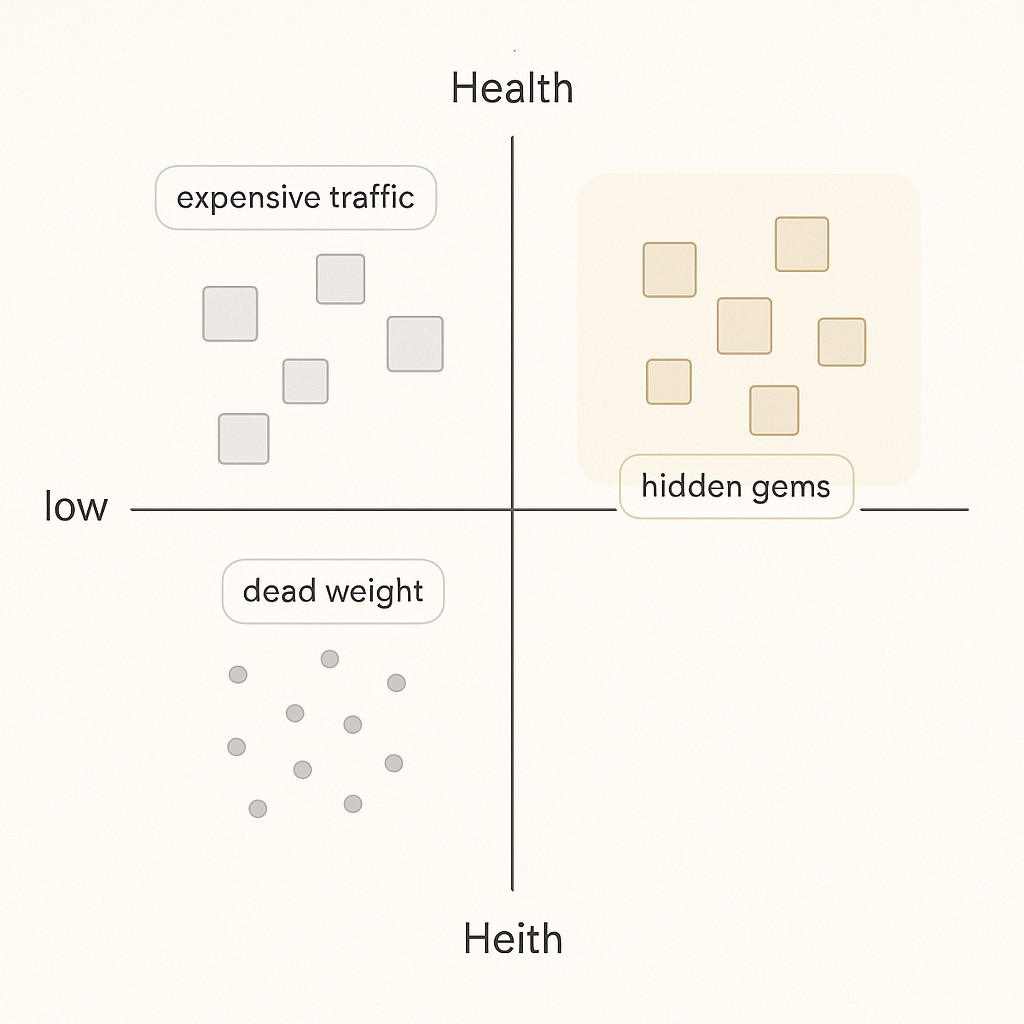
Let’s draw the full matrix. Imagine your entire content library plotted on a grid within a content relevance framework, with Article Health running left to right, and Article Relevance top to bottom. Each article sits in one of four quadrants—high health/high relevance (your gold), high health/low relevance (expensive traffic), low health/high relevance (hidden gems), or low health/low relevance (dead weight). The real breakthrough comes when you prioritize work that strengthens both axes. Flagship pieces that rank and convert don’t just move isolated needles—they create compounding ROI.
Traffic supports conversion, conversion justifies traffic.
Single-axis wins might boost a metric, but only dual wins multiply the actual business impact over time. That’s how you break out of noise and build momentum that lasts.
Mapping Your Content: The SEO and Conversion Content Audit Sprint
Let’s be honest—there’s never a “right time” to run an SEO and conversion content audit across your whole site. A while back, I knew I needed to audit everything on both axes, and I committed to a tight, focused sprint. A couple afternoons, max, and you’ll unlock clarity that pays for itself tenfold.
For Article Health, keep it simple. I run through each post, asking: is the quality up to par (honest writing, good visuals, no fluff), do content audit SEO fundamentals hold up (title tags, meta descriptions, real keyword targeting), is the readability clear (can someone scan and actually take action), does the structure help (headers, logical flow), and does it link well internally? Fast proxies help me move. Check for decent SERP position, impressions in Search Console, and crawl health using any site audit tool. I give each piece a quick rating—green for “healthy,” yellow for “needs work,” red for “getting buried.” No science, just signal.
Relevance, though, is about fit. I map pain-to-solution alignment—does this post actually answer what my ICP worries about? I check if the keywords show buyer intent or just curiosity, and in a conversion-focused content audit I make sure CTAs aren’t generic but actually clear the path to conversion. Talking to sales always exposes blind spots (I keep learning this the hard way), and peeking at assisted conversions in analytics flags the posts that matter in real deals.
Here’s the shortcut: in a B2B content audit, prioritize optimizing high-relevance, low-health posts as quick wins closest to converting. Posts targeting keywords with commercial intent convert at rates up to 10x higher than informational topics Ahrefs/CXL. So you’re literally one good audit away from surfacing gold hidden in plain sight—where a handful of tweaks can unlock real revenue.
This might be a bit off-path, but I once spent an afternoon mapping out old posts using colored paper cards spread all over my living room floor. My partner came home, stepped over five “yellow” posts and just shook her head. It looked a little over the top, but something about laying it out physically made it click for me: there really were hidden wins just under my nose. No dashboard does that for you.
Start your next high-relevance draft fast—use Captain AI to generate a free article, then tune structure, internal links, and CTAs to improve health and conversions.
Operating Content Like Assets: Where ROI Compounds
Start treating high-Health, high-Relevance articles like assets that get sharper over time. Update them regularly, tighten the internal links pointing in and out, and keep an eye on what’s moving the conversion needle. If you want compounding returns, this is the bucket that earns its keep.
Now, for high-Relevance but low-Health posts, these are usually quick wins hiding just beneath the surface. Tweak the on-page signals—like titles and metadata—add support articles that clear up related hurdles, and actually wire them into your site’s healthy architecture with links from stronger pages. Don’t just let them drift. Every nudge you make here lifts real potential. You’ll be surprised at how much low-hanging fruit you’ve ignored once you start refreshing and integrating these outliers.
When you’re looking at articles with strong Health but low Relevance, it’s a judgment call. Either refocus the intent, or let them go cold. I’ve warned earlier about “expensive traffic”—those big sessions that quietly burn cash and momentum. Rankings alone are a vanity metric if they aren’t driving qualified clicks or leads. Traffic without conversions doesn’t move the business forward, and there’s no upside in propping up empty numbers.
Flagship assets need ongoing care. Keep them fresh—both in substance and signals—link to them from every new post where it fits, and build them into your main conversion flows. If you haven’t yet, sketch out a living internal link map. It helps you see how value travels through your ecosystem, not just which pages get a click.
Set a regular review pulse. Monthly or, at worst, quarterly. Track which posts are climbing, which are sliding, and which are suddenly sending relevant leads. When you reinforce wins on that cadence, that’s when you see compounding ROI kick in. It’s a system, not a gamble, and it stacks performance over time instead of chasing the latest trick.
Handling the Hard Part: Time, Traffic, and the Two-Axis Shift
I get it—there are two main reasons you’d hesitate to jump into this. One, the idea of investing even more time just “auditing content.” Two, that gnawing feeling when someone suggests sidelining posts that drive traffic (“I just need to write for my audience!”). Nobody wants to kill the thing keeping sessions high.
But here’s the thing. Deprioritizing isn’t deleting. You’re not turning off good traffic; you’re shifting resources toward the articles that actually convert, and retargeting what’s misaligned. Remember earlier—content that ranks for the wrong audience is just expensive traffic. You don’t have to let it eat your budget while better-fit content sits in the dark.
Here’s how to start without blowing up your calendar. Pick five posts—just five. Map your posts, rate each for health and relevance, and choose one as your quick win. Set a 30-day update cadence. This is about momentum, not perfection. You’re building the habit before scaling up.
I still find myself checking rankings on posts that probably should just be cut loose. Old habits die hard. Maybe that’s okay—I haven’t figured out how to stop watching that vanity traffic, but at least now it doesn’t set the direction.
Compounding ROI comes from doing the right work, not more work.
Stay focused on the two-axis system—forget vanity metrics and chase results that last month after month.
Enjoyed this post? For more insights on engineering leadership, mindful productivity, and navigating the modern workday, follow me on LinkedIn to stay inspired and join the conversation.