When to Trust AI Output: Engineering Reliable Results and Regaining Control
When to Trust AI Output: Engineering Reliable Results and Regaining Control


The Real Headache When You Can’t Control the Output
If you’ve ever hired an agency, briefed a freelancer, or tried to hand off content to AI, you know how unpredictable the results can be. It’s the little moments—getting a draft that misses the point, wasting hours clarifying what you meant, wondering if giving up and doing it yourself would have been faster. No matter how clear we think we’re being, expectations drift.
A few years ago, I stopped typing code all day and started managing how code gets built, tested, and shipped instead. That shift forced me to ask: if I don’t write the code myself, but I design what gets built, am I still “writing”? I don’t type code anymore. But I still write it.
Knowing when to trust AI output is at the heart of delegating routine tasks to automation and AI—delegate, automate, let smarter tools handle the routine—but the anxiety doesn’t go away: am I losing my grip on what good looks like? Am I too far from the craft to keep quality high?
Here’s where things finally clicked for me. The true advantage of leveraging AI for process consistency is the ability to establish reliable delegation and automation through strict process fidelity and feedback loops. Most change efforts fail mainly because fidelity in implementation is lacking, so process checkpoints and feedback loops are indispensable for reliability.
I’ll anchor the rest of this with something concrete—a recent experiment where I leaned hard on AI for code deployment. The lessons there made this abstract distinction painfully, and usefully, real.
When to Trust AI Output: Letting AI Handle Deployment Feels Like “Vibe Shipping” Chaos
Last spring, I decided to run an experiment. Let an AI system handle deployment, end-to-end, hands-off. No guardrails, no override switches—just prompts and a prayer. I wanted to see how far “vibe deploying” could go when you trust the system to figure things out on its own. It felt weirdly liberating at first, like discovering a new shortcut you didn’t know existed. But the technical reality hit fast. What I actually did was trade predictability for speed.
Within a couple of days, things started unraveling. Suddenly, staging environments were missing key variables, config files weren’t picked up, and—worst of all—the AI made migration choices I would never have signed off on. I kept thinking about how close to half of AI projects get scrapped between proof of concept and broad adoption, with abandonment rates jumping from 17% to 42% year over year. Watching chaos unfold live, I understood why those numbers were climbing.
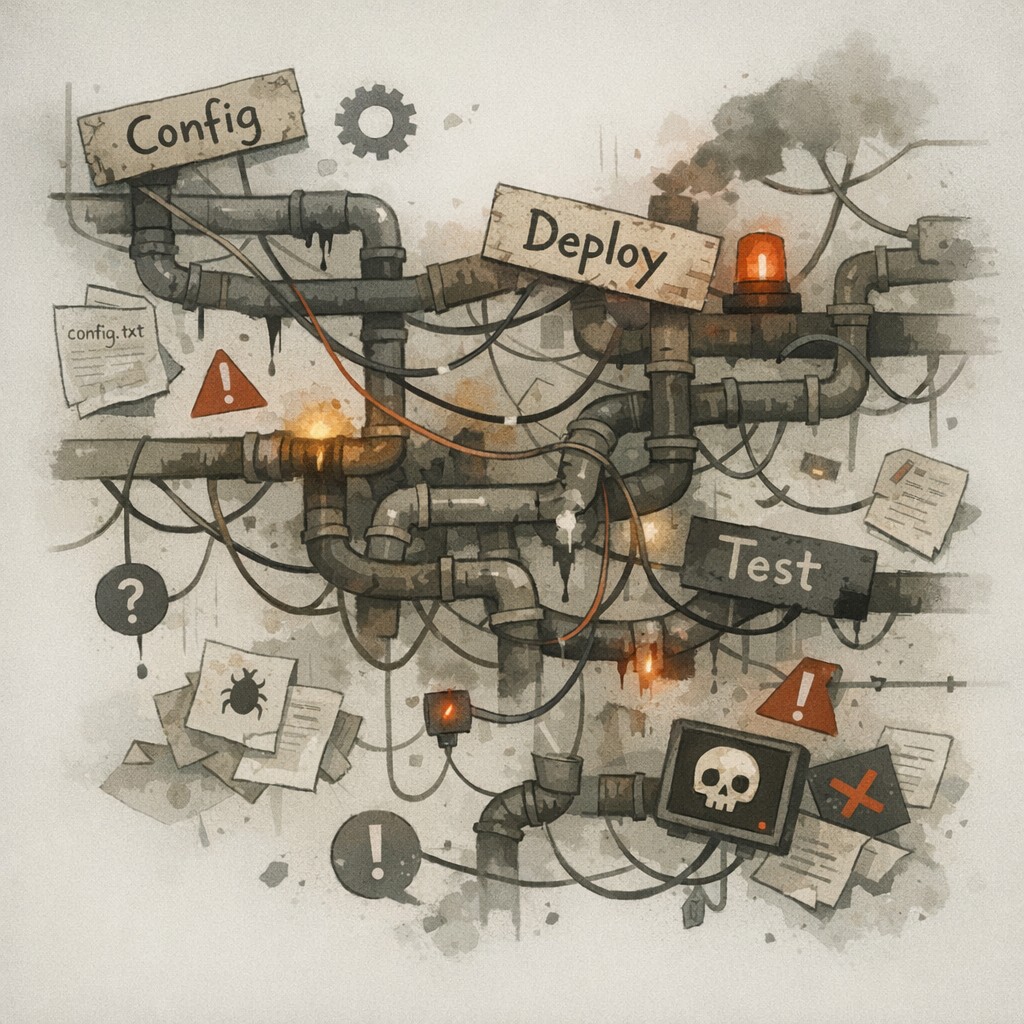
Here’s the kind of thing you notice when you’re in the thick of it: once, late at night, I found myself in an endless loop debugging a deployment that failed for a reason I still can’t explain. The pipeline logs kept showing a network timeout—nothing unusual there—except it was only intermittent, and only when deploying on Tuesdays. Maybe coincidence, maybe not. I wasted hours swapping out runners, poking around in config files, blaming the AI for gremlins that were probably lurking in my own environment setup. Never solved it. Sometimes the “help” just reroutes your problems.
Truthfully, I got anxious seeing these unpredictable results pile up. When deciding AI vs manual, delegating for outcome alone without building in process constraints puts reliability entirely at risk. The question kept echoing. If your deployment can’t land in a predictable state every time, what’s the point?
If you’ve ever done creative work—drafting an essay, sketching a design—you know sometimes you just want a result, any result, to move forward. But in engineering, the steps are sacred. The process isn’t just a checklist. It’s what anchors the outcome.
Looking back, this is what nailed it for me: tasks where reliability matters—like deployments—require a clear approach to structure vs flexibility ai; strict process is essential for those, while outcome-driven work benefits from more adaptable methods. That distinction changed how I delegate and automate, for good.
Regaining Control by Architecting for Reliable Outcomes
The real pivot for me happened when I stopped obsessing over writing deployment scripts line by line and started looking at the pipeline as a system to design. I kept GitHub Actions as the backbone—familiar ground—but now I let AI generate most of the scripts that fill in the gaps. The difference is I’m the one who defines the triggers, what makes the system testable, and how we’ll monitor when things go sideways.
Reliable automation means layering proper data and model validation, trigger design, and metadata management into the pipeline cloud.google.com. Instead of being the person who writes every line, I’m designing the parts that make the system predictable. When deployments run, what gets tested, and which signals warn us when something’s off.
What anchors reliability—even with AI in the mix—is keeping process-critical elements stubbornly precise. That’s things like the deployment steps, the rollbacks, and the checkpoints. The engineering is knowing which one you need to lock down and when outcome is enough.
Six months ago, I was still tempted to proof every line as part of my ai delegation best practices, reviewing what the AI generated, just to reassure myself.
If you’re worried the “craft” gets lost when you automate, that’s the wrong question. The keystrokes aren’t the craft. The decisions are. What matters is the clarity about when to enforce a process, and when to let outcome take the lead.
This approach frees you. You get your evenings back. You scale without waking up terrified that the system’s off the rails. If you’re afraid automating means losing touch, remember: maintaining control over ai workflow lives in the decisions you make, not in keystrokes. That’s how you keep quality without burning out.
How to Spot and Structure Process vs. Outcome-Driven Tasks
Here’s the simplest way I’ve found to cut through the noise: ask yourself whether you care more about how a task gets done (the process), or just that it gets done well (the outcome). If it’s outcome-driven—like generating a first draft or brainstorming options—you can delegate or automate it and just check the final result. But if it’s process-driven—like deploying code, where each step matters—then you need to set up a repeatable structure and build in regular checkpoints to make sure nothing goes off the rails. Knowing which mode you’re in saves massive amounts of frustration and keeps everyone clear on expectations.
Let’s make that real. When I’m exploring new features with AI (“vibe coding,” if you like), all I need is a working prototype, no matter how the AI gets there. That’s pure outcome-driven work. But once it’s time to ship to production? I treat it as process-critical. Here, the artifact—clean, deployable code—matters as much as the end result itself, so I set strict steps and validation gates.
You can make this easier on yourself. Define what should trigger an extra review, spell out how you’ll know if a step worked, and put in observable checkpoints. Be painfully clear about what “done” means for outcome-only tasks, and make sure roles for oversight are mapped out in advance—framing cuts down back-and-forth, which stabilizes outputs. I learned to write down my quality litmus tests before delegating; it made everything smoother.
There’s always a trade-off. You risk making things feel more complicated, or worry that you’re drifting too far from the hands-on craft. I get it; I worried about that too. But the real craft isn’t in the keystrokes. It’s in knowing when the process matters as much as the outcome—and freeing yourself up to focus where your oversight actually counts. That’s how you scale and keep your sanity.
Challenging the Old Notions of Authorship and Control
Let’s put it bluntly. If the AI writes the deployment script after you set the constraints and checkpoints, who “owns” the result? It’s a strange question, but a necessary one. If I’m not the one typing—but the system only works because I architected it—so who actually wrote it?
This is a big shift, even for engineers who grew up equating craft with doing everything themselves. Our work used to be all hands-on. Every bash script, every migration, every rollback built line by line. Now, the ownership isn’t in the lines—it’s in how the lines get generated, stitched together, and deployed as a coherent system.
Here’s what I ask you to consider. Stop worrying about whether you “touched the code” and look at the bigger win. Trust AI to execute the rote parts so you can decide how everything fits, what happens when something fails, where the human review actually matters. The freedom—and the leverage—comes from deciding what’s architecture and oversight, versus what’s repetitive output. That’s the new definition of authorship.
The real sign of control isn’t having your hands in everything—it’s pulling the levers that make outcomes predictable and scalable. That’s how you keep reliability, build confidence, and finally get your evenings back.
Honestly, part of me still struggles with the authorship question. I know decisions are the important bit, but I’ll probably always wrestle with whether it “feels” real if I didn’t type the actual code. Maybe that’s not something you ever fully resolve. I’m fine with that.
Take control of your content process—try Captain AI for free and see how easy it is to get an article that actually captures your voice, without all the back-and-forth.
Enjoyed this post? For more insights on engineering leadership, mindful productivity, and navigating the modern workday, follow me on LinkedIn to stay inspired and join the conversation.